Joe, don’t go into the light!
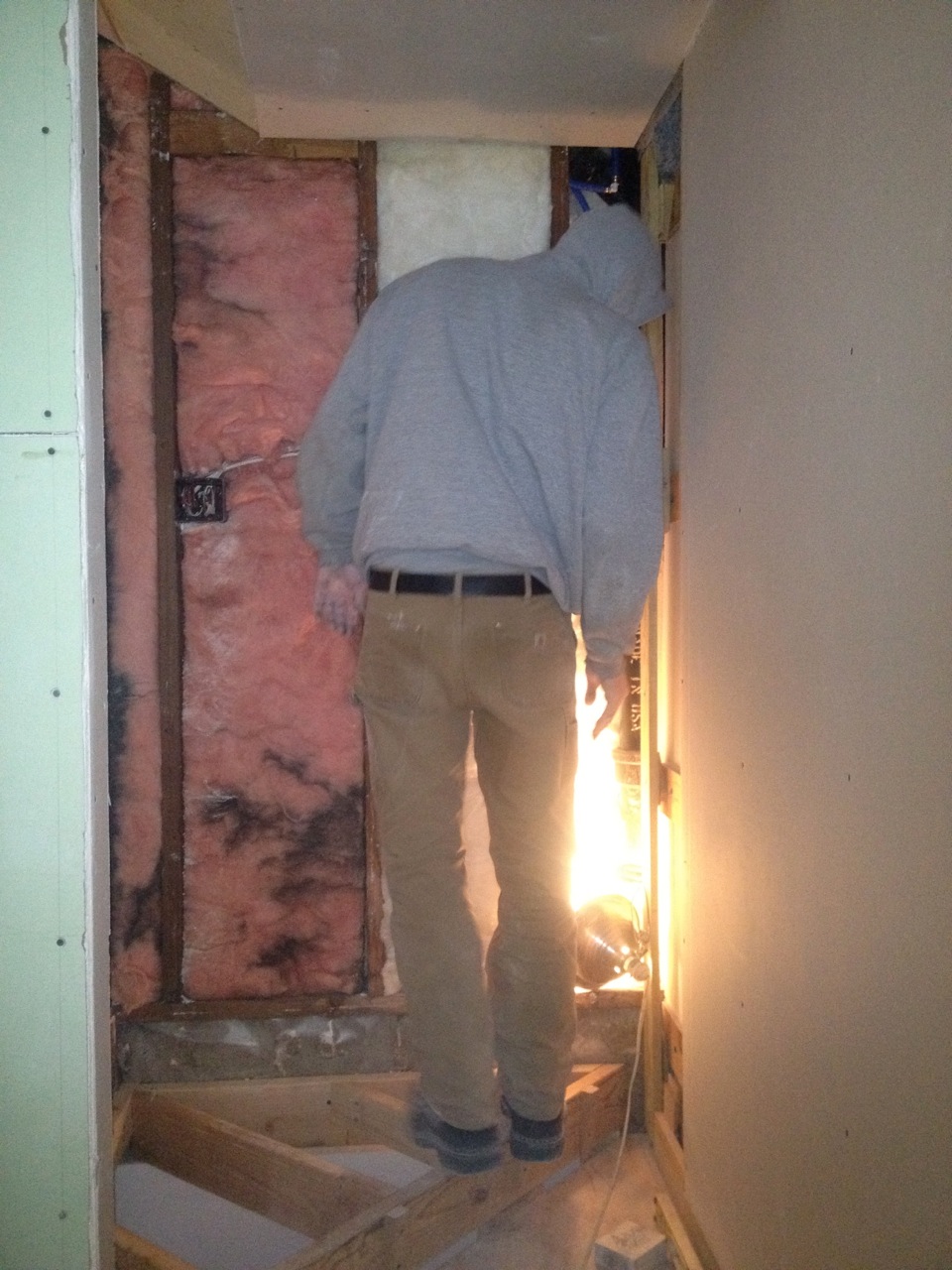
David, look out for the people under the stairs!
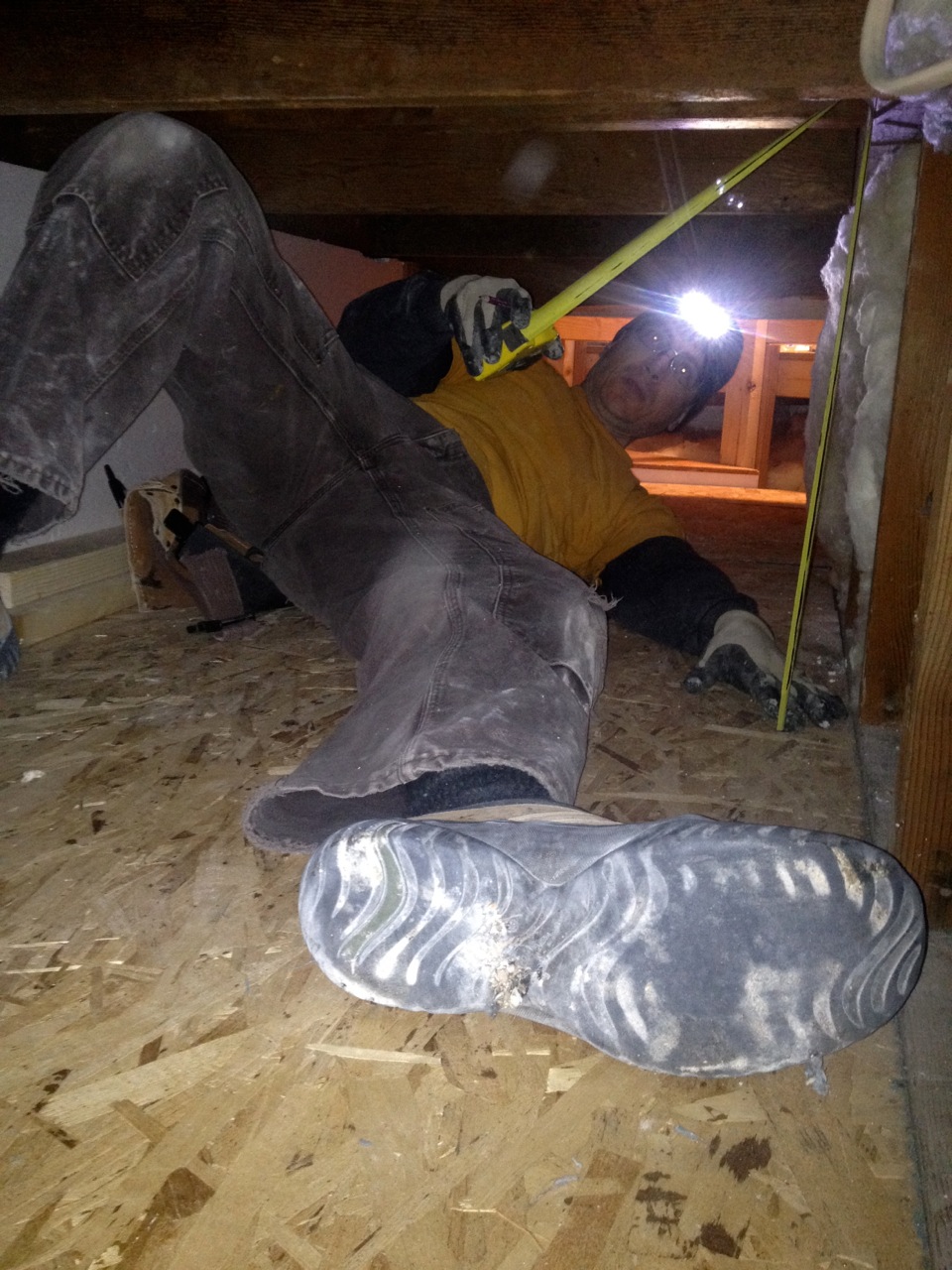
Or you might call this entry Insulating and Sheetrocking in all the Hard Places You’ve Been Avoiding.
Joe, don’t go into the light!
David, look out for the people under the stairs!
Or you might call this entry Insulating and Sheetrocking in all the Hard Places You’ve Been Avoiding.
Hard to believe but it’s a balmy 52 degrees out in January (the snow is melting like mad) and sheetrocking of the walls downstairs should be done today!
The bathroom actually looks like a room now. Remember what it looked like just a few days ago? The short hallway you enter to get to it is almost done…
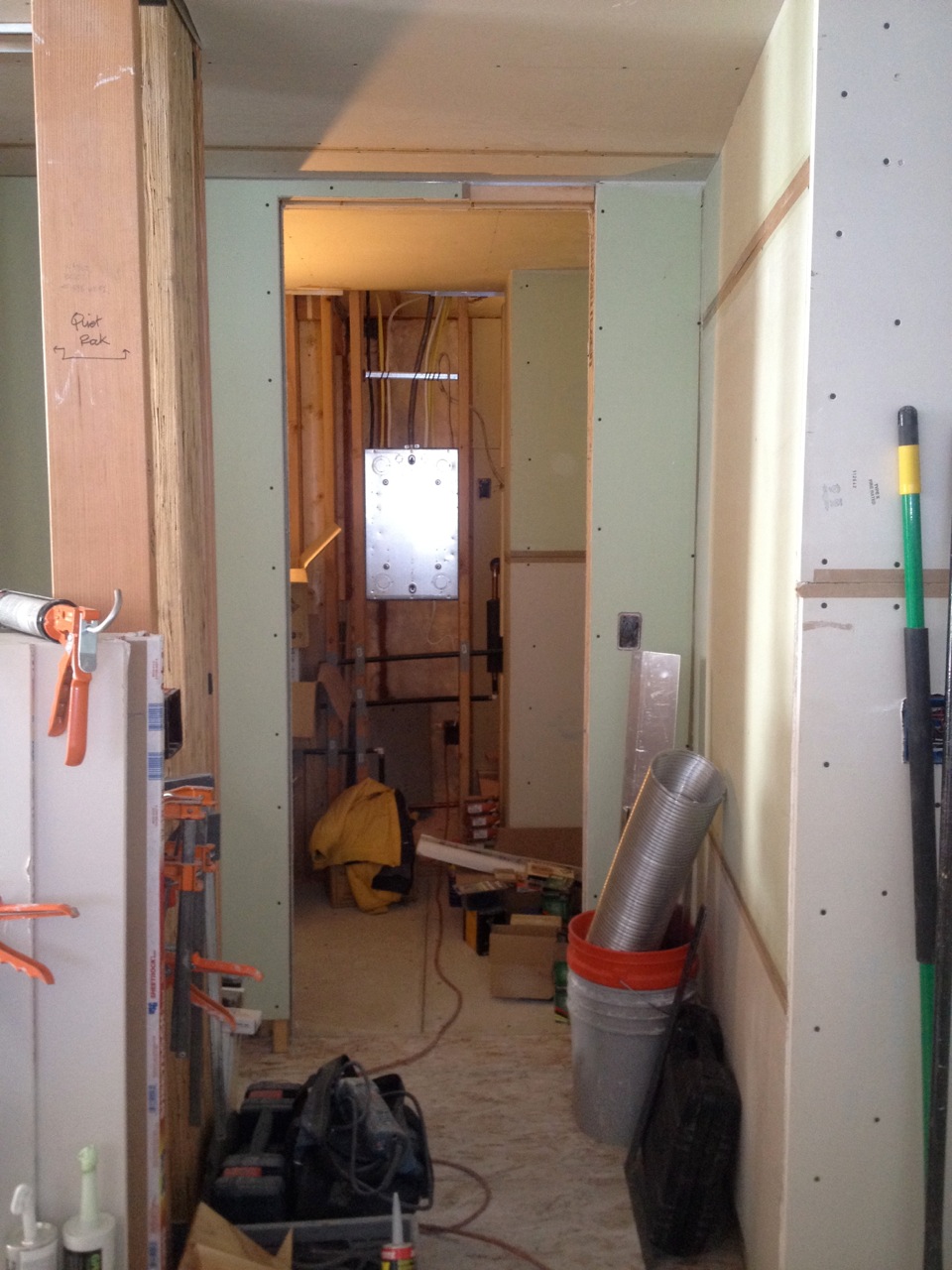
To the left you can just begin picture the future wet bar in the alcove…
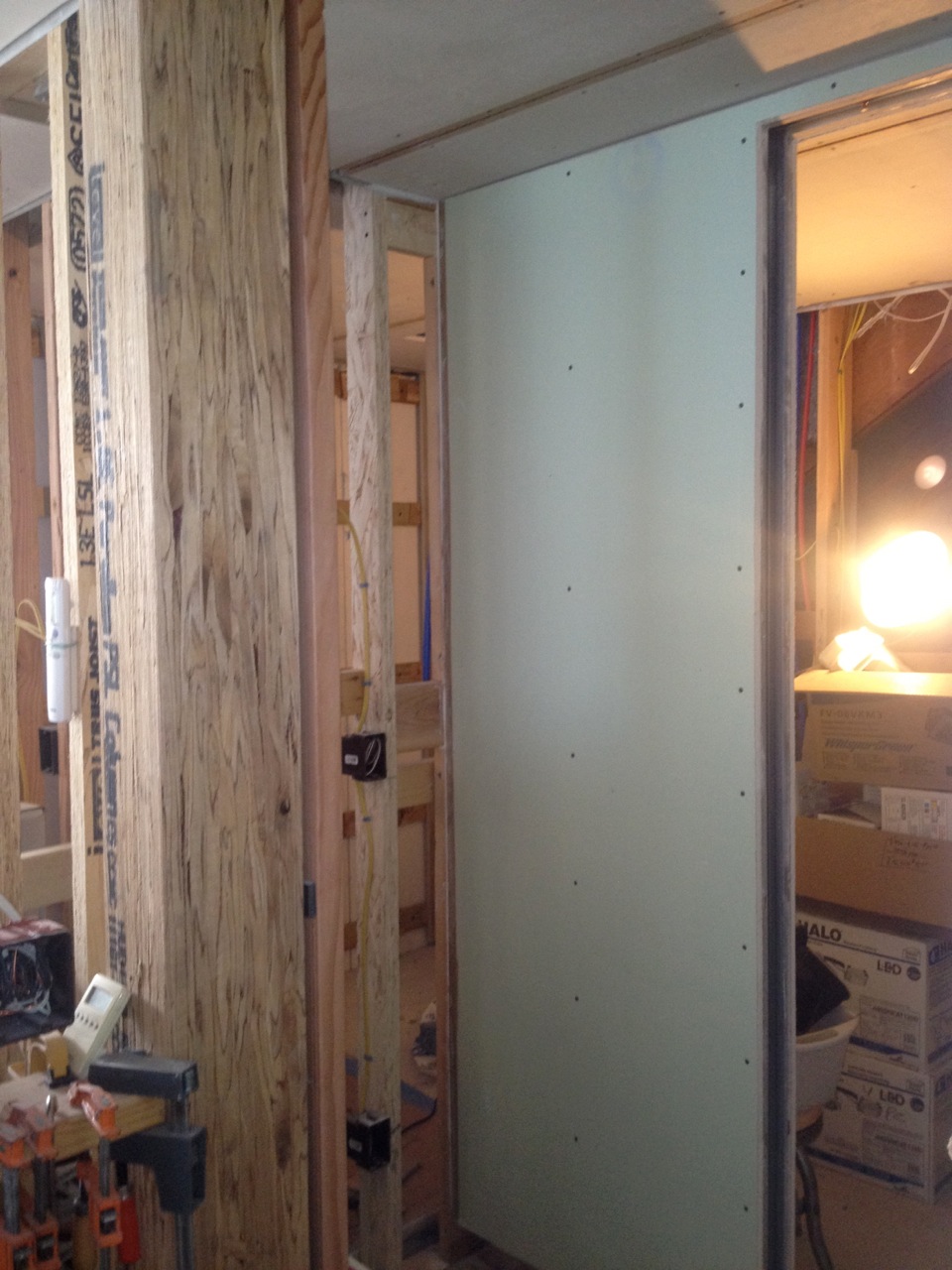
And now there’s the actual doorway to the bathroom instead of just framing…
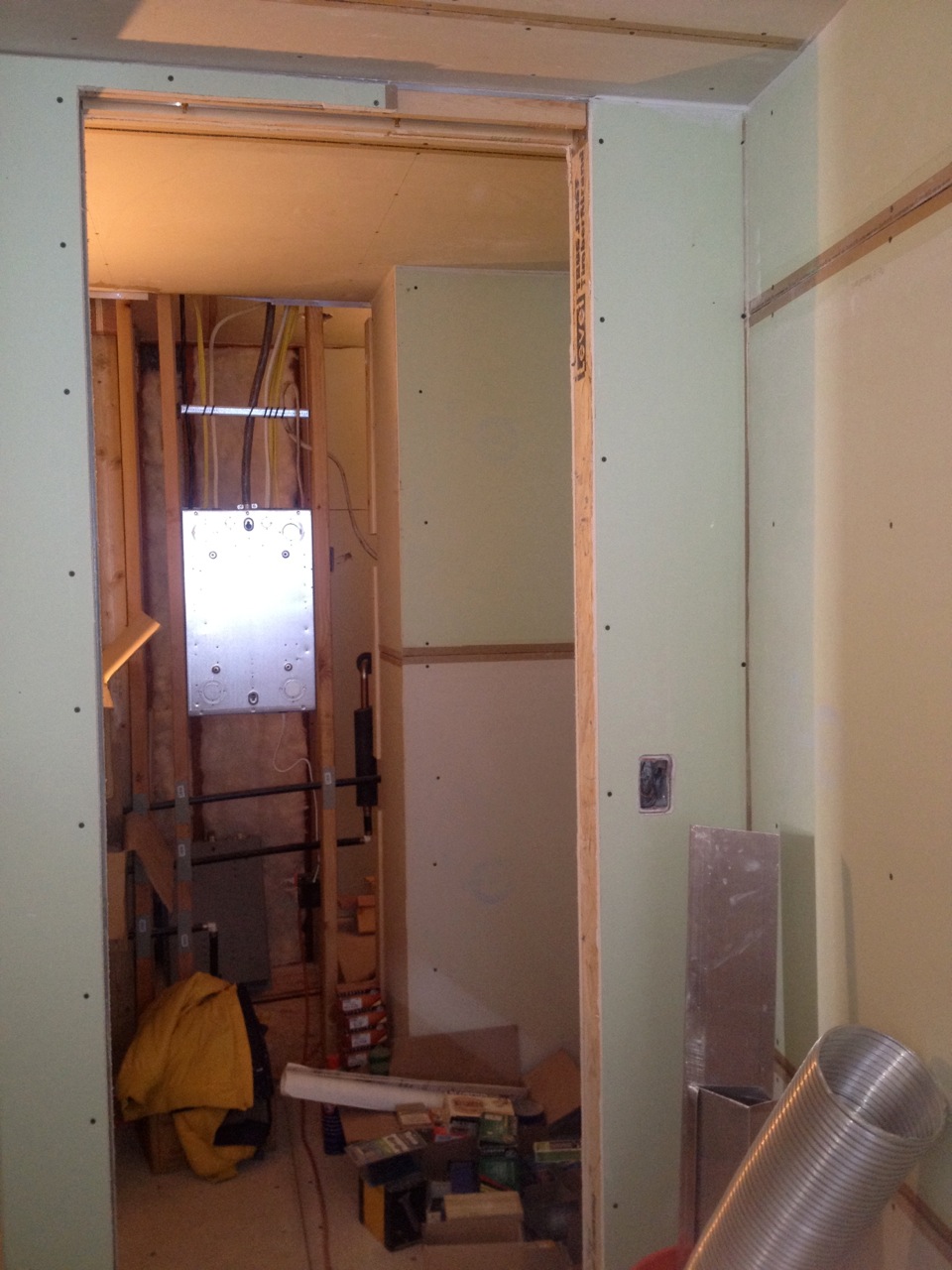
On the left side of the doorway there’s slot to tuck in a pocket door…
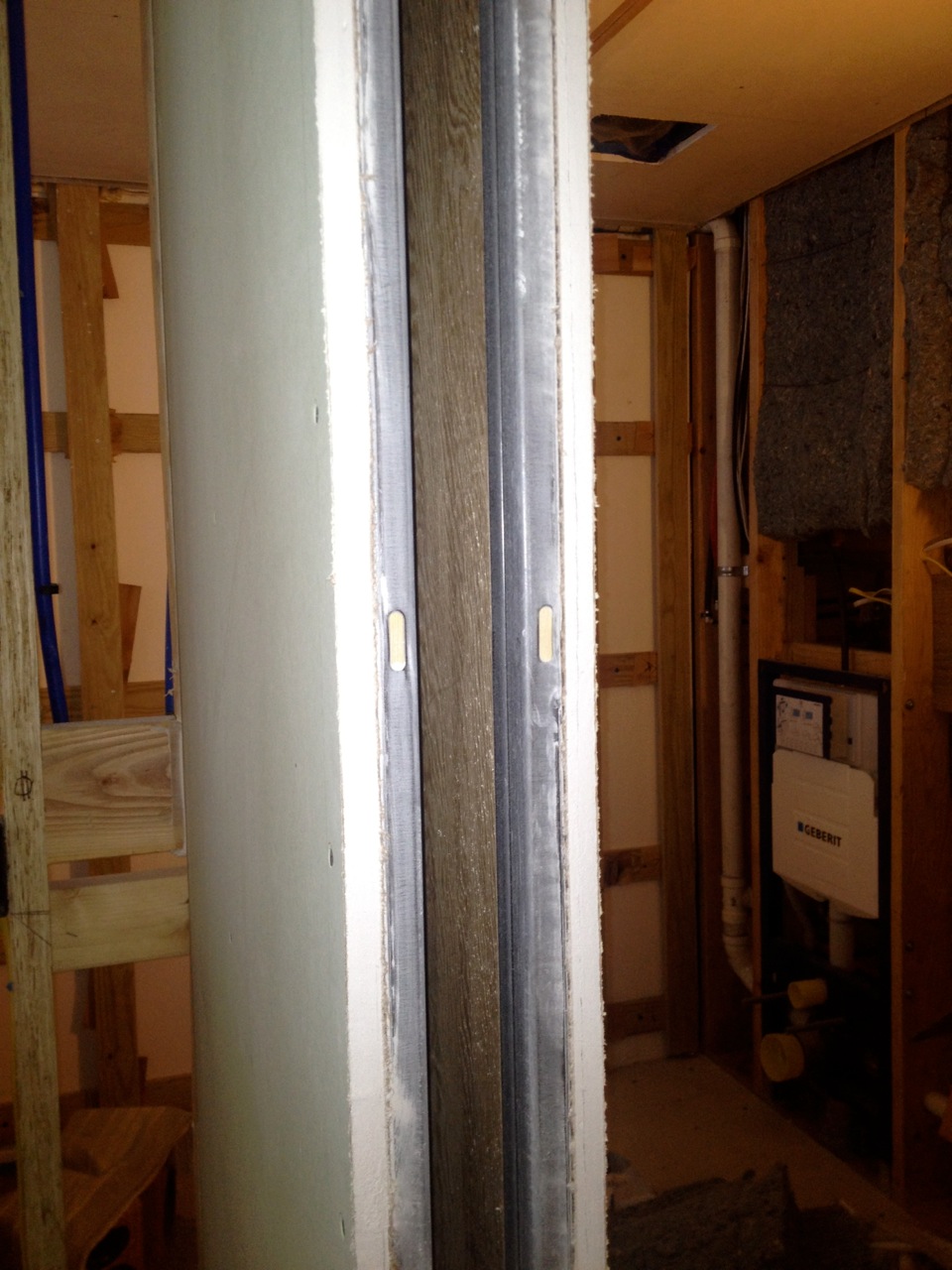
Since it’s a small bathroom we wanted as much usable space as possible. A swinging door just didn’t make sense in here.
Step inside and you’ll see the entry wall is sheetrocked now…
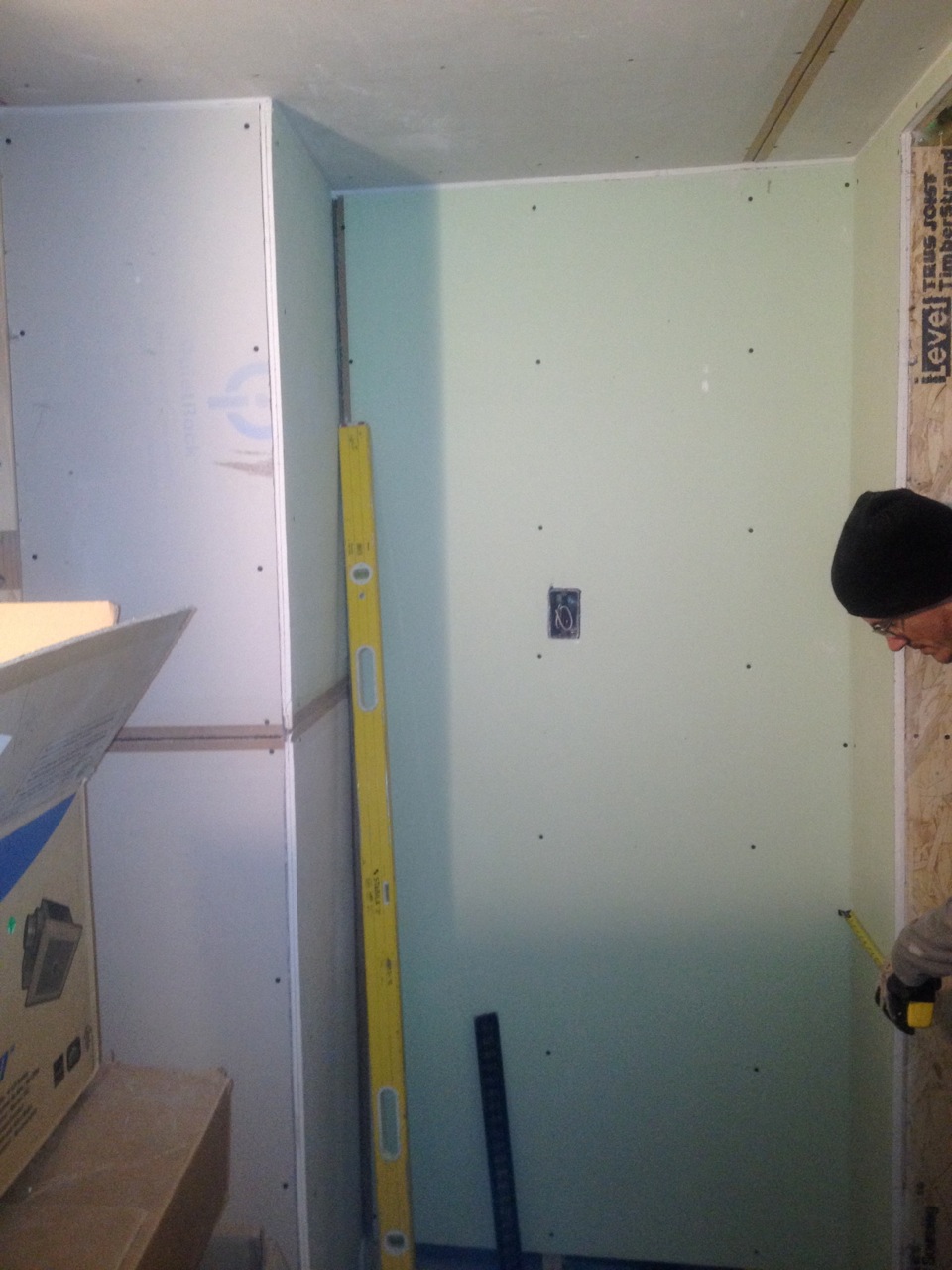
The bathroom wall adjacent to the shower (that’s the shower in the shadows on the right) is also sheetrocked…
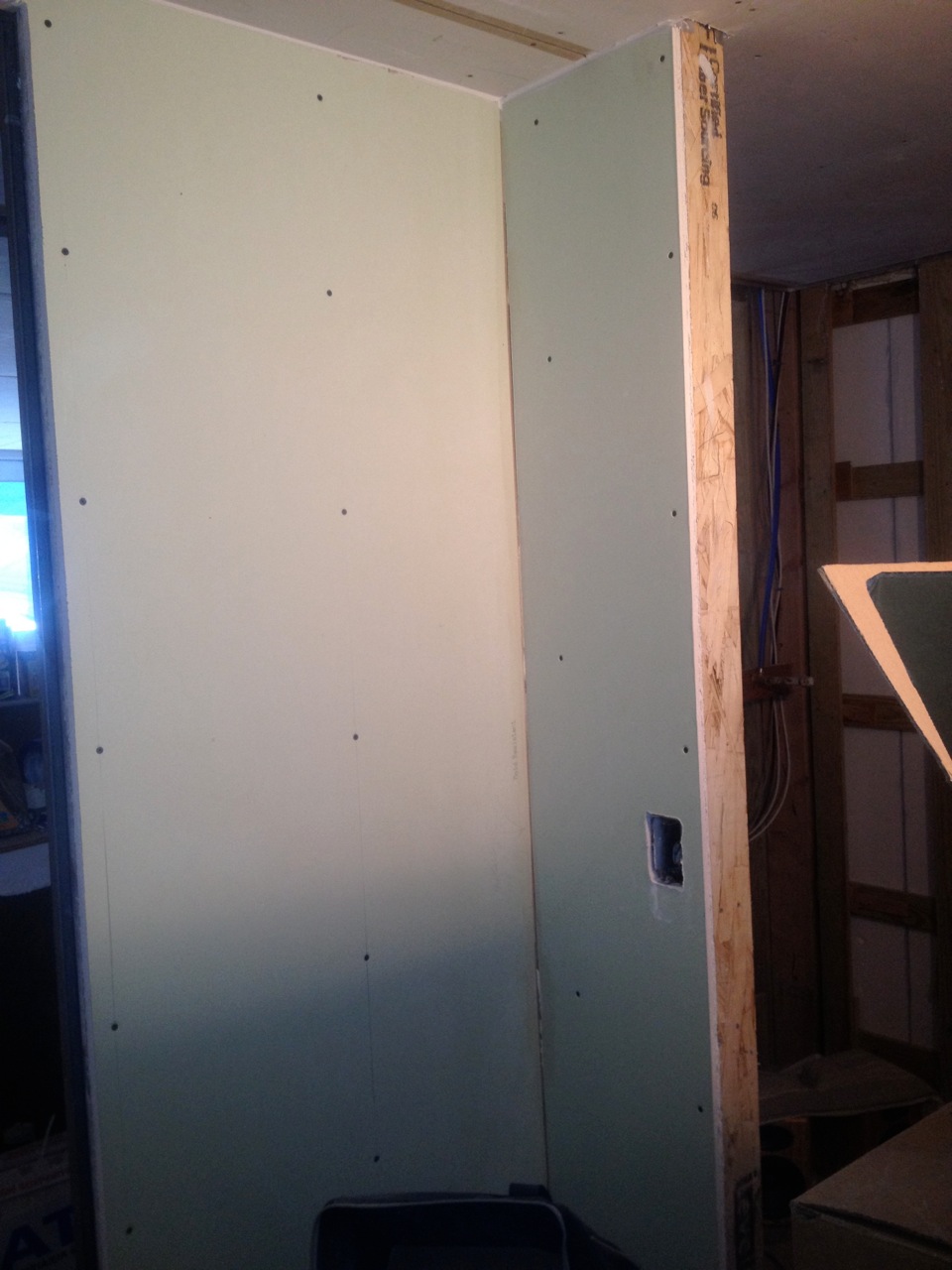
More to come. In the meantime, David and Joe are busy trimming and fitting and pounding away…
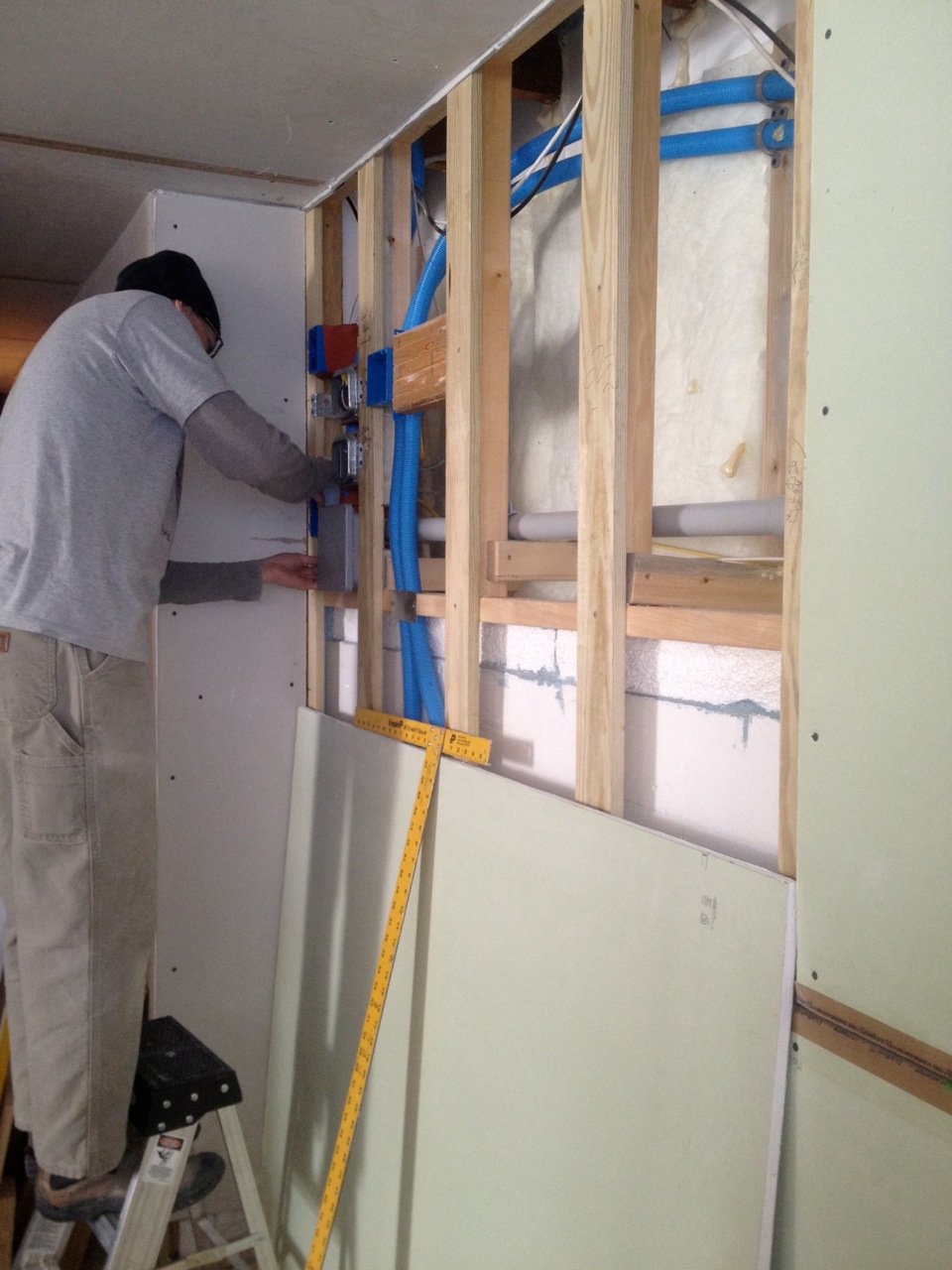
Lookin’ good, boys!
As promised, walls started going up today. First Joe soundproofed the gap between the ceiling and soon-to-be-wall with acoustical sealant …
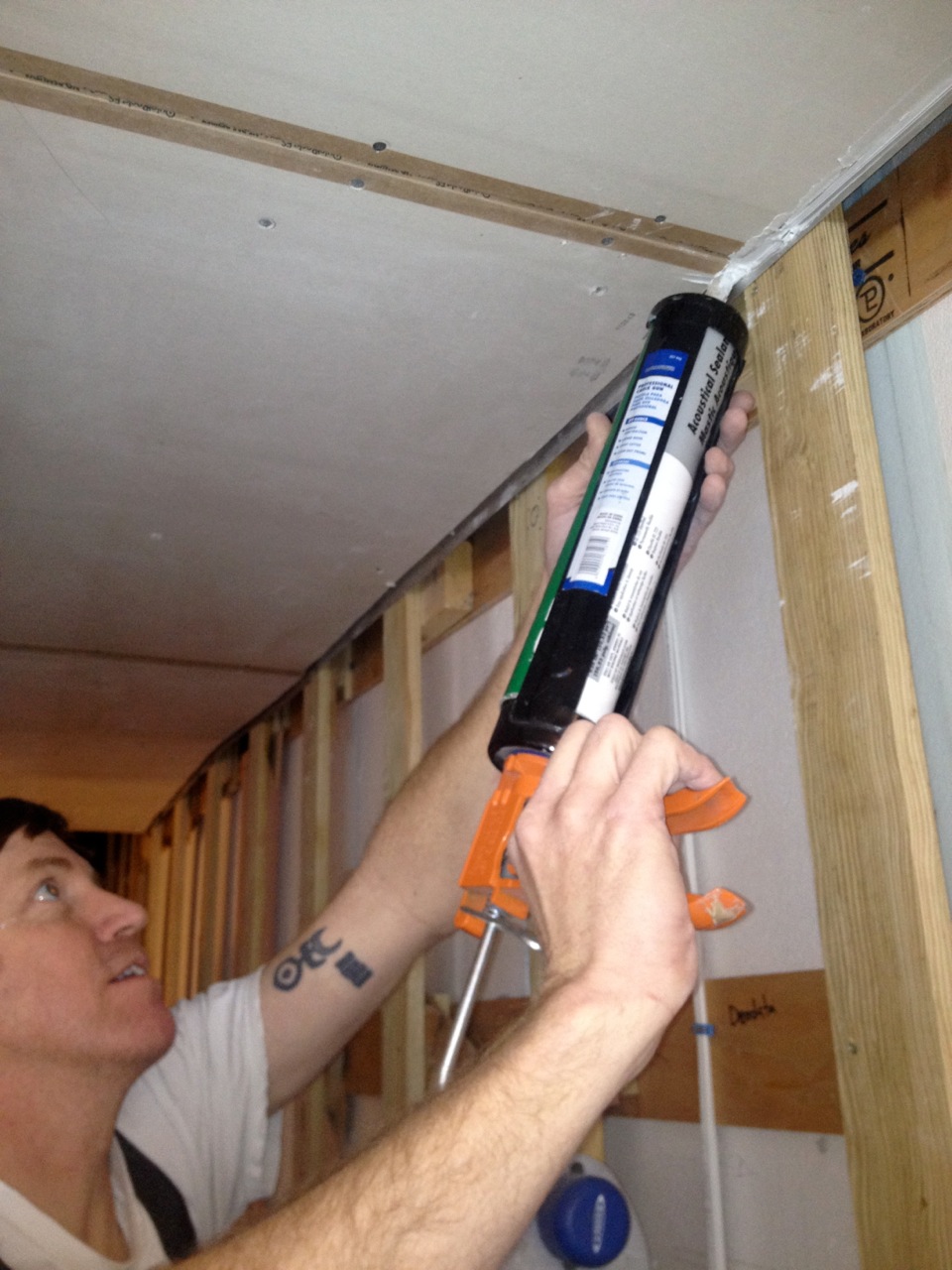
Followed by sheetrock…
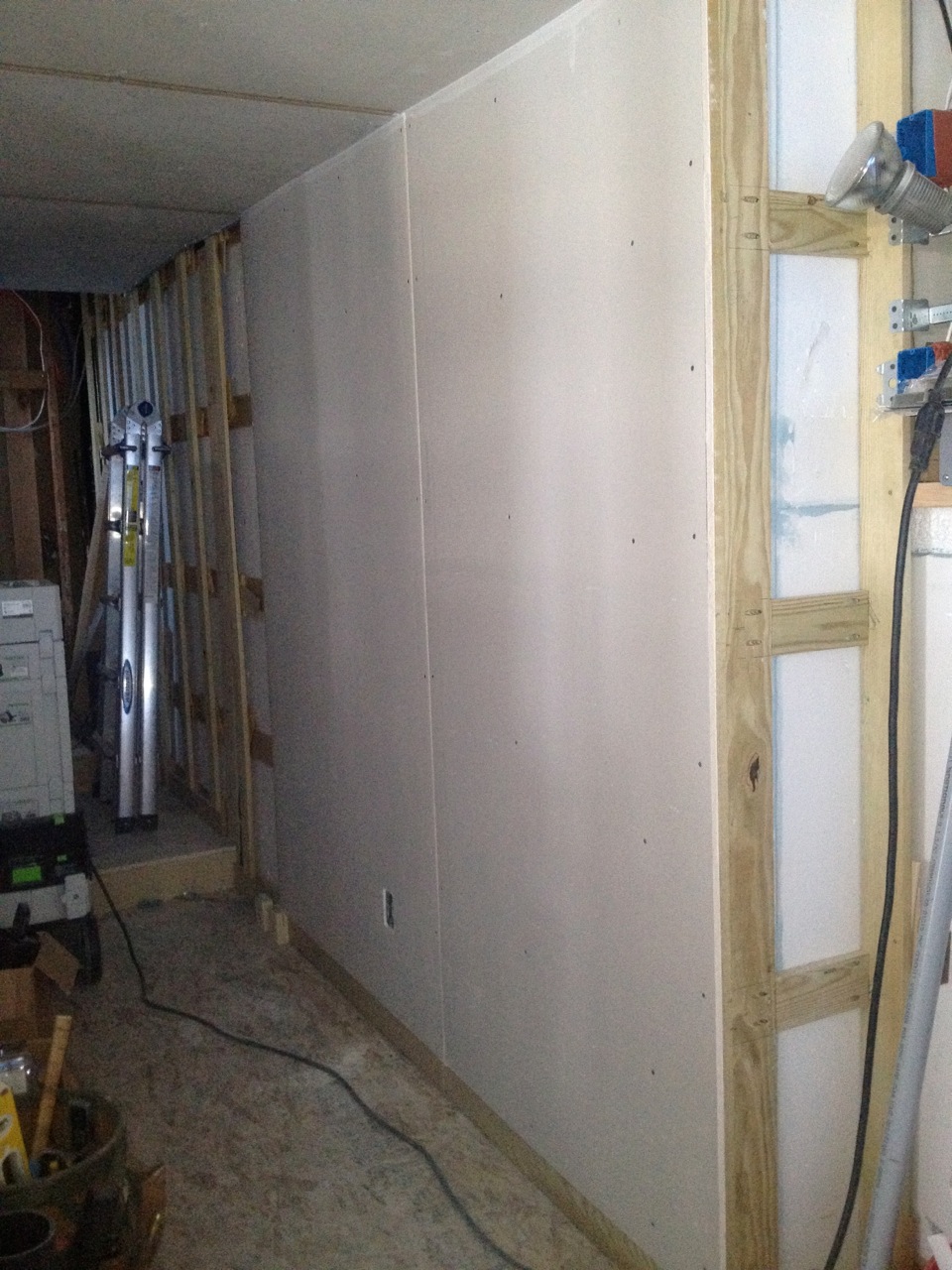
Honest-to-gawd walls are happening!
Sheetrock, that is. This time for the walls. Two separate loads arrived…
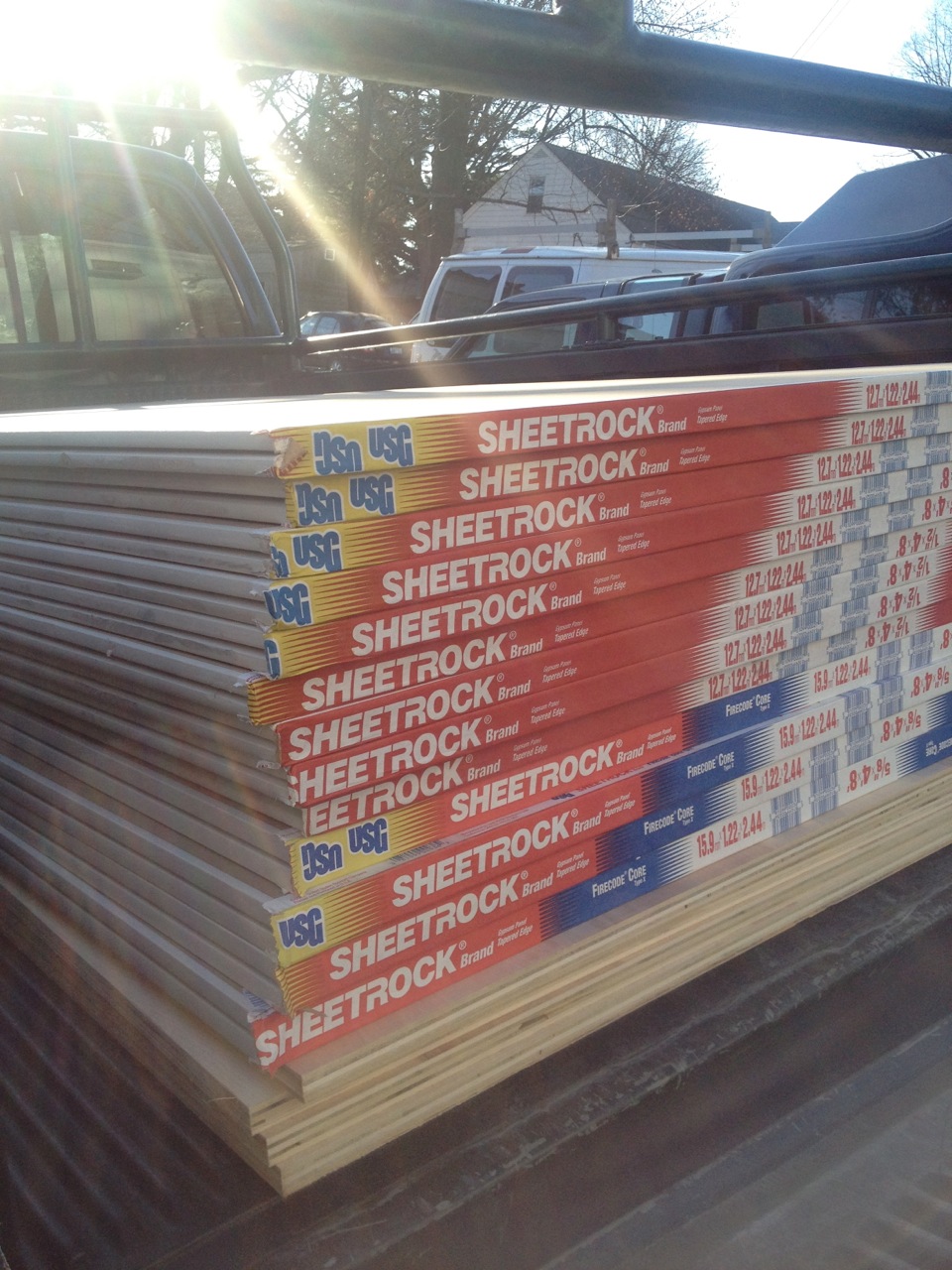
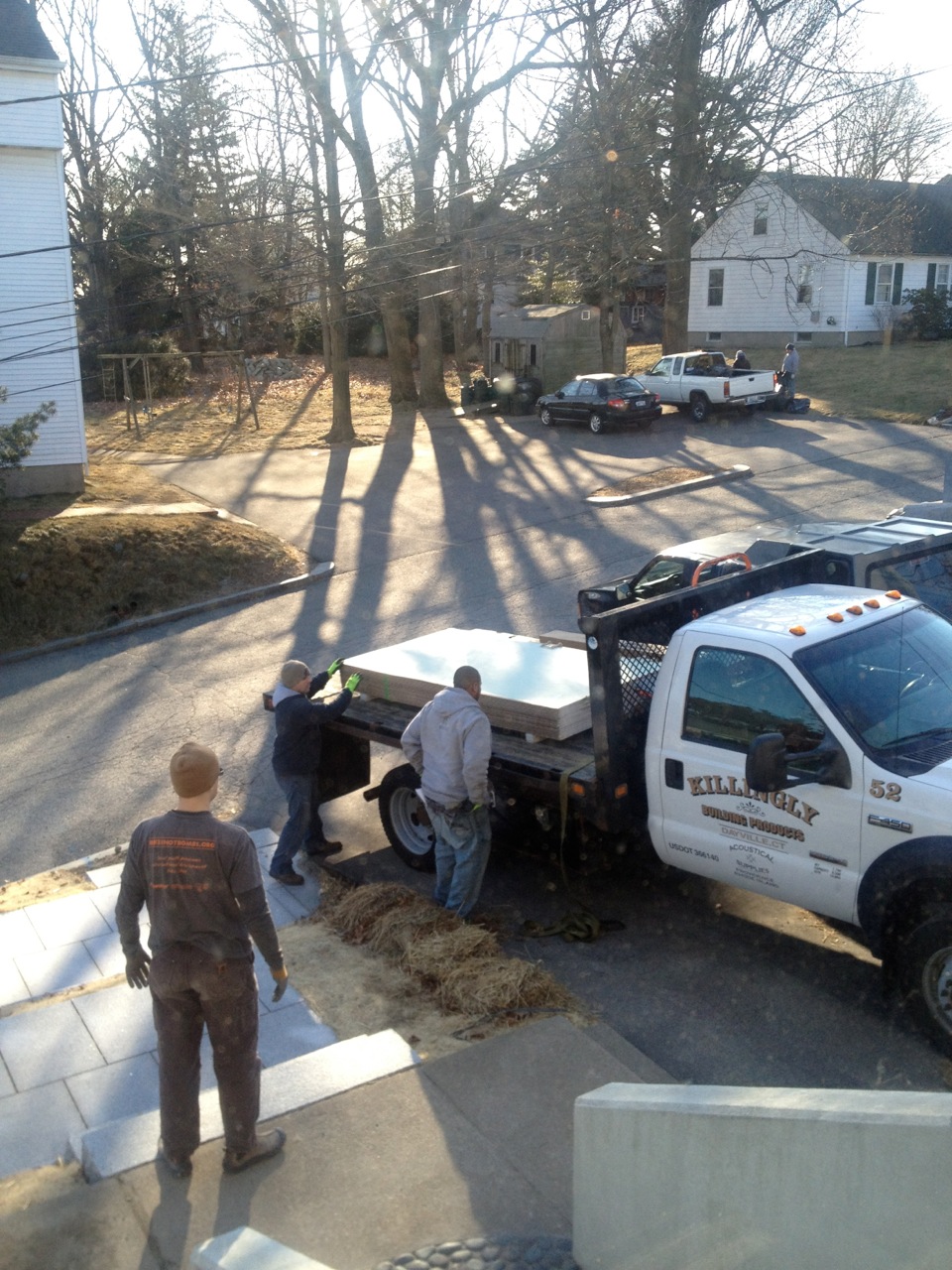
The boys are just about done QuietRocking the ceiling downstairs…
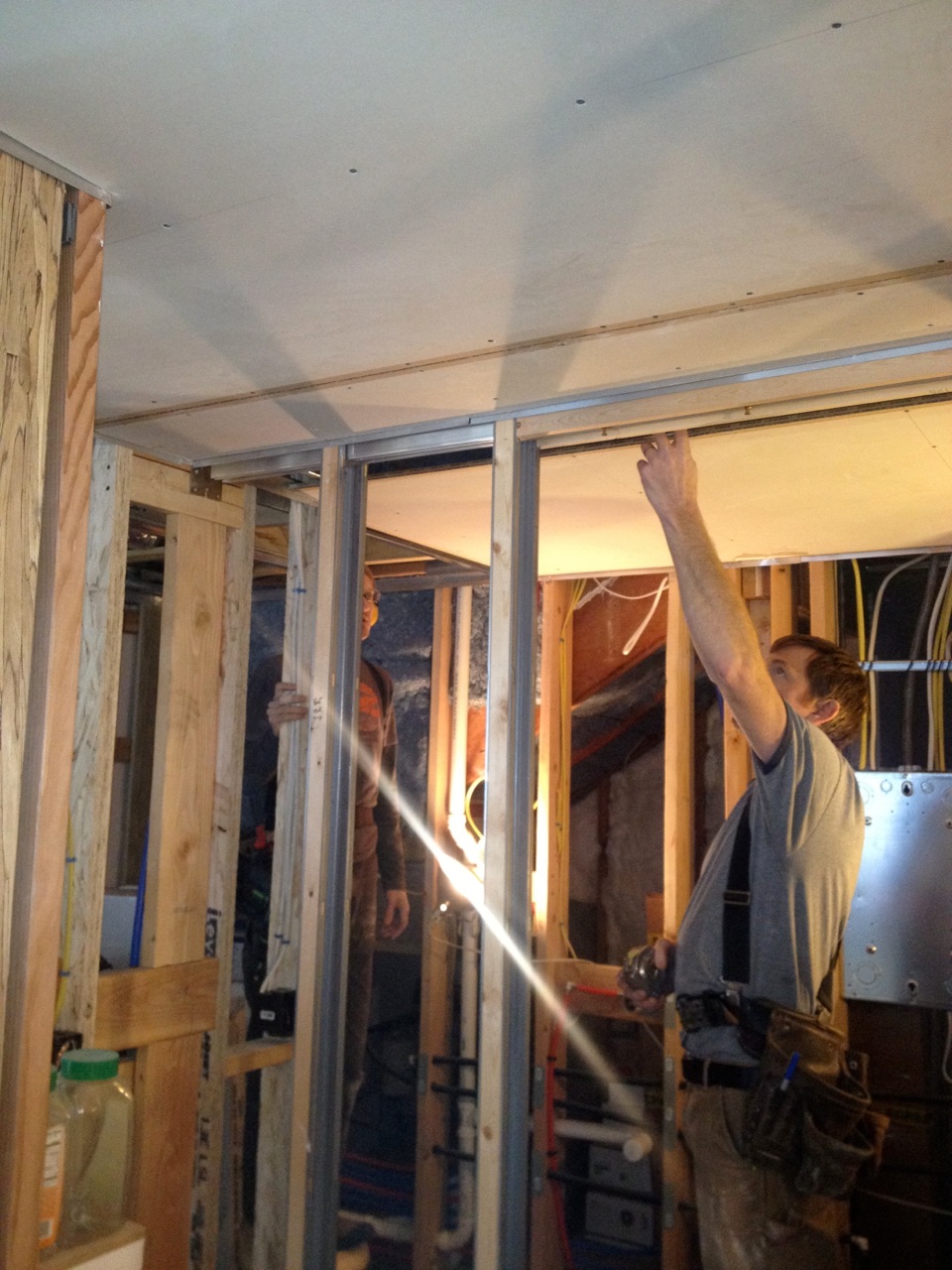
That’s the bathroom — the ceiling got insulated only yesterday. I’m liking this pace. All that sheetrock-in-waiting means walls will be next. Yay!
So what’s up down? Well, David and Joe have been busy since their last round of ceiling-up-putting with final prep for closing up the walls and ceiling. Tell us all about it, David…
——————————————————————————————-
The hallway got its energy-efficient, eco-conscious makeover. Now fully denimated and insulated…
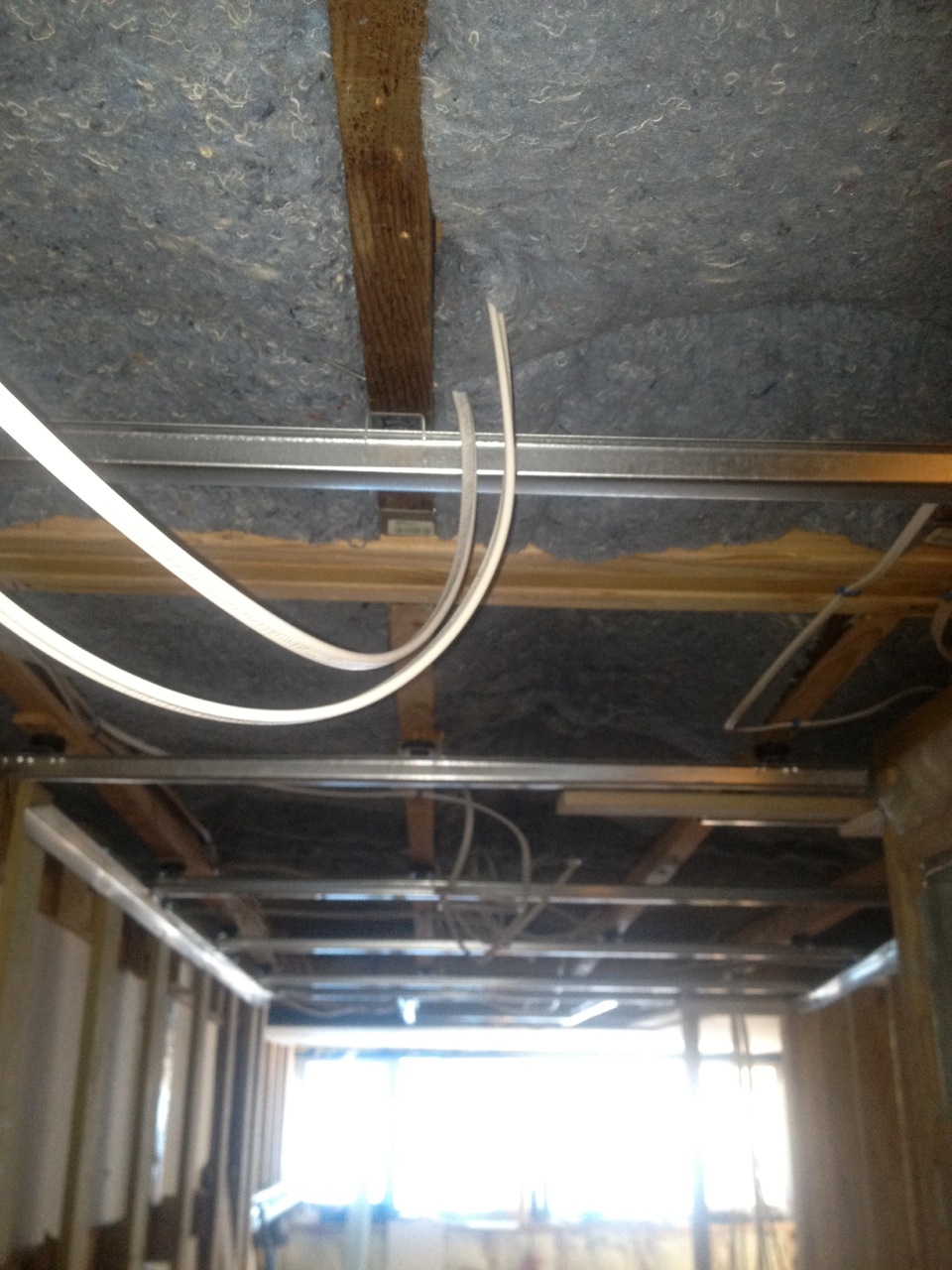
That ridiculously frigid storage area under the stairs got the same treatment…
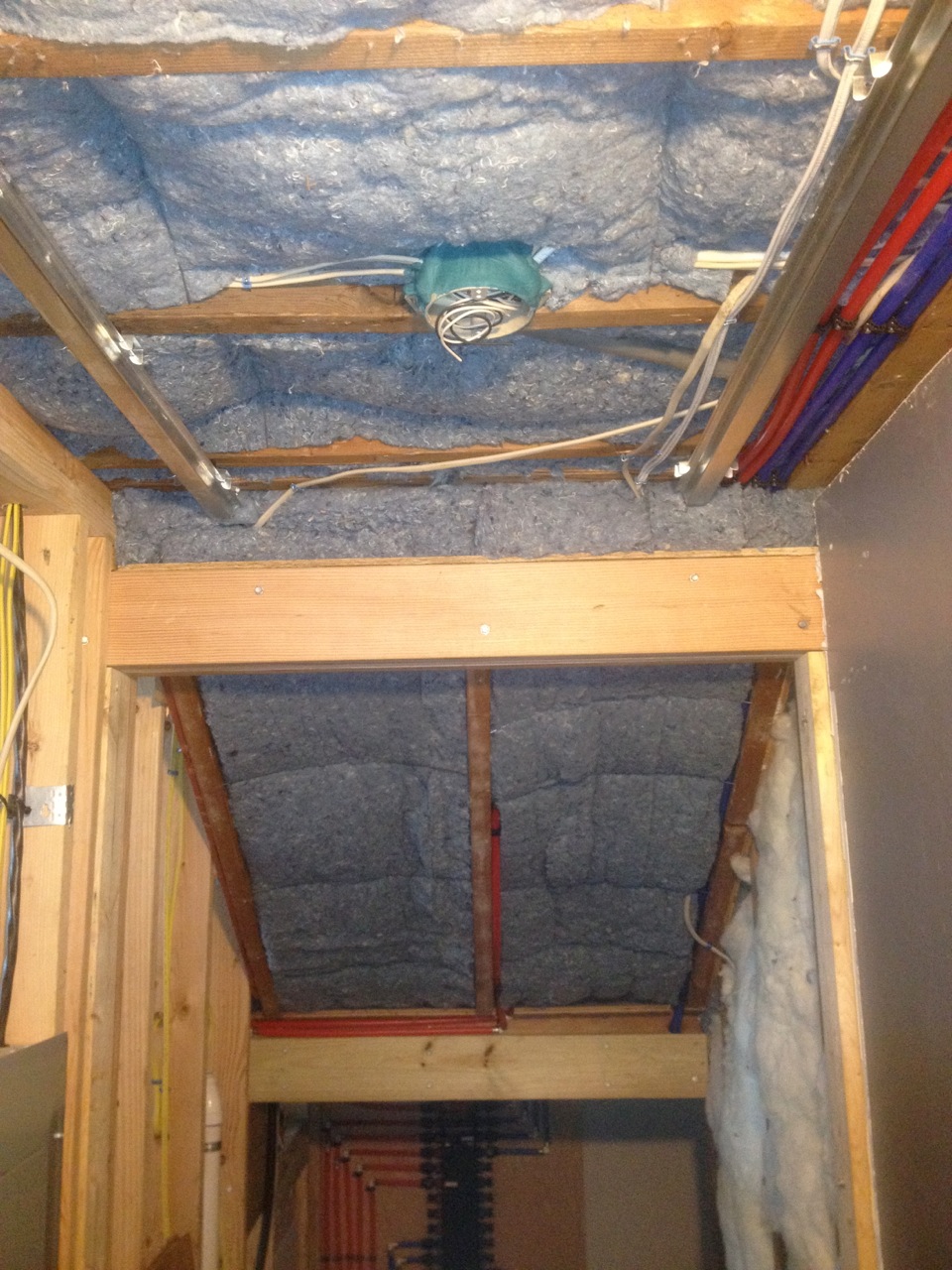
And the bathroom will now be much warmer and cozier, too…
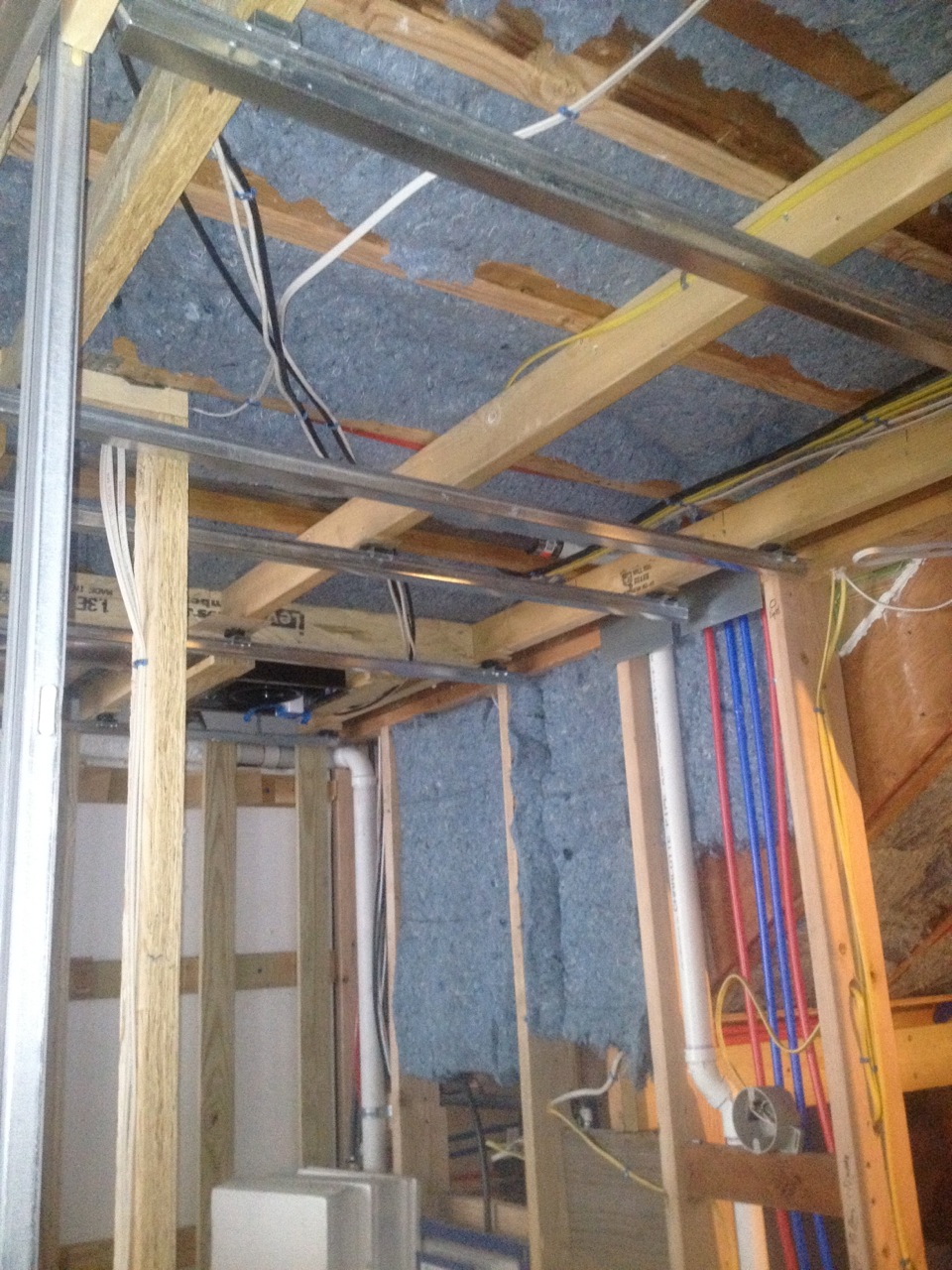
Including the shower…
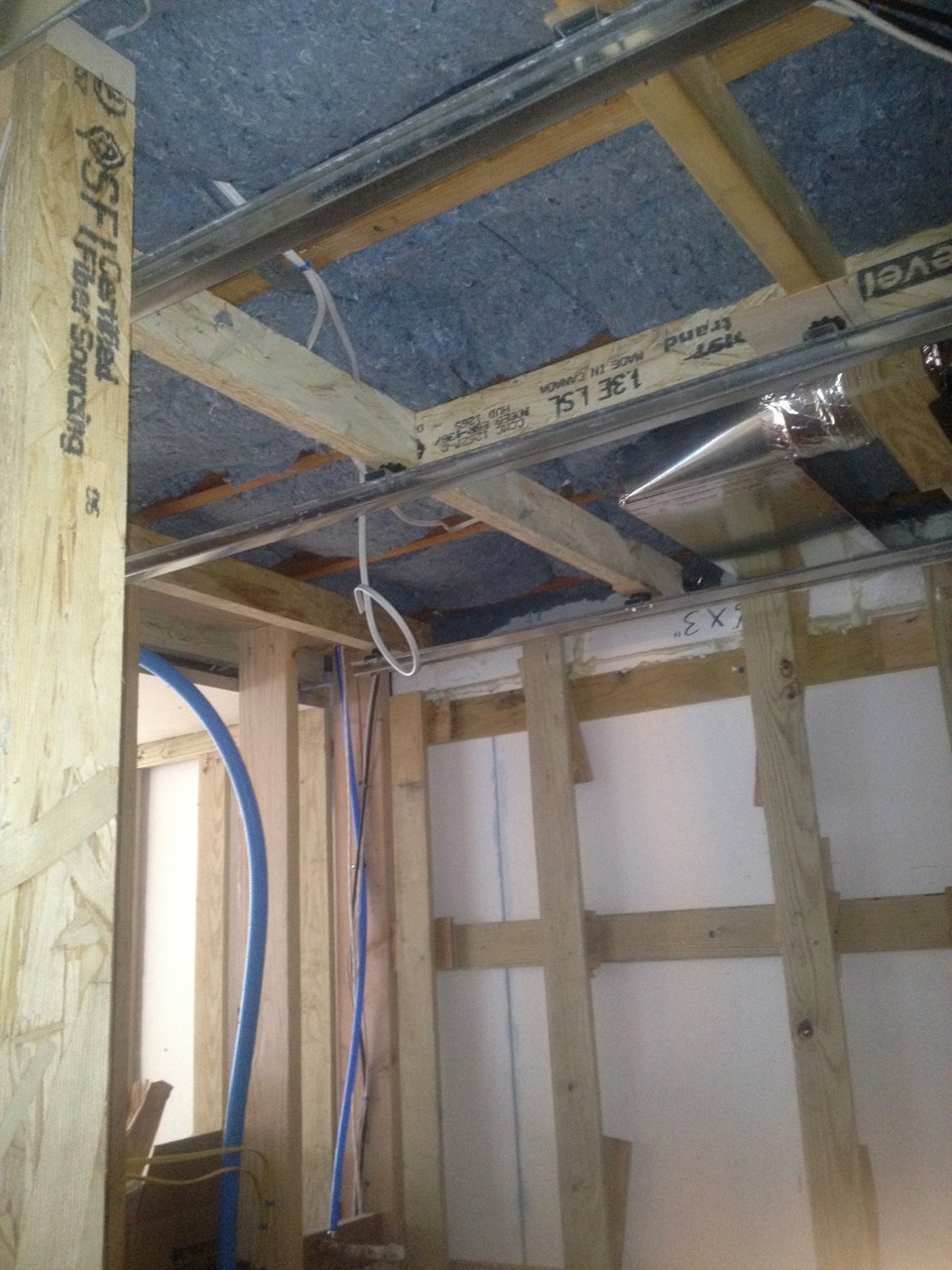
[The concrete foundation wall was insulated earlier with 3″ EPS — the floor was also insulated, so it will definitely be more snug in here even after we tile. Gyp board (sheetrock) is the next step.]
Our electrician got all the new wiring roughed in downstairs — we passed inspection, which is why Joe and I are able to button things up. Our old electrical panel was code-compliant in 1971 but had since become outdated with a grounding system no longer acceptable. So we now have a nice shiny new 100-amp box.
All electrical boxes and ceiling lights are getting special soundproofing. Heavy putty pads are wrapped around them which block air (and noise) from getting through all the little holes and openings. The pads also add mass to the boxes so they won’t vibrate and transmit sound…
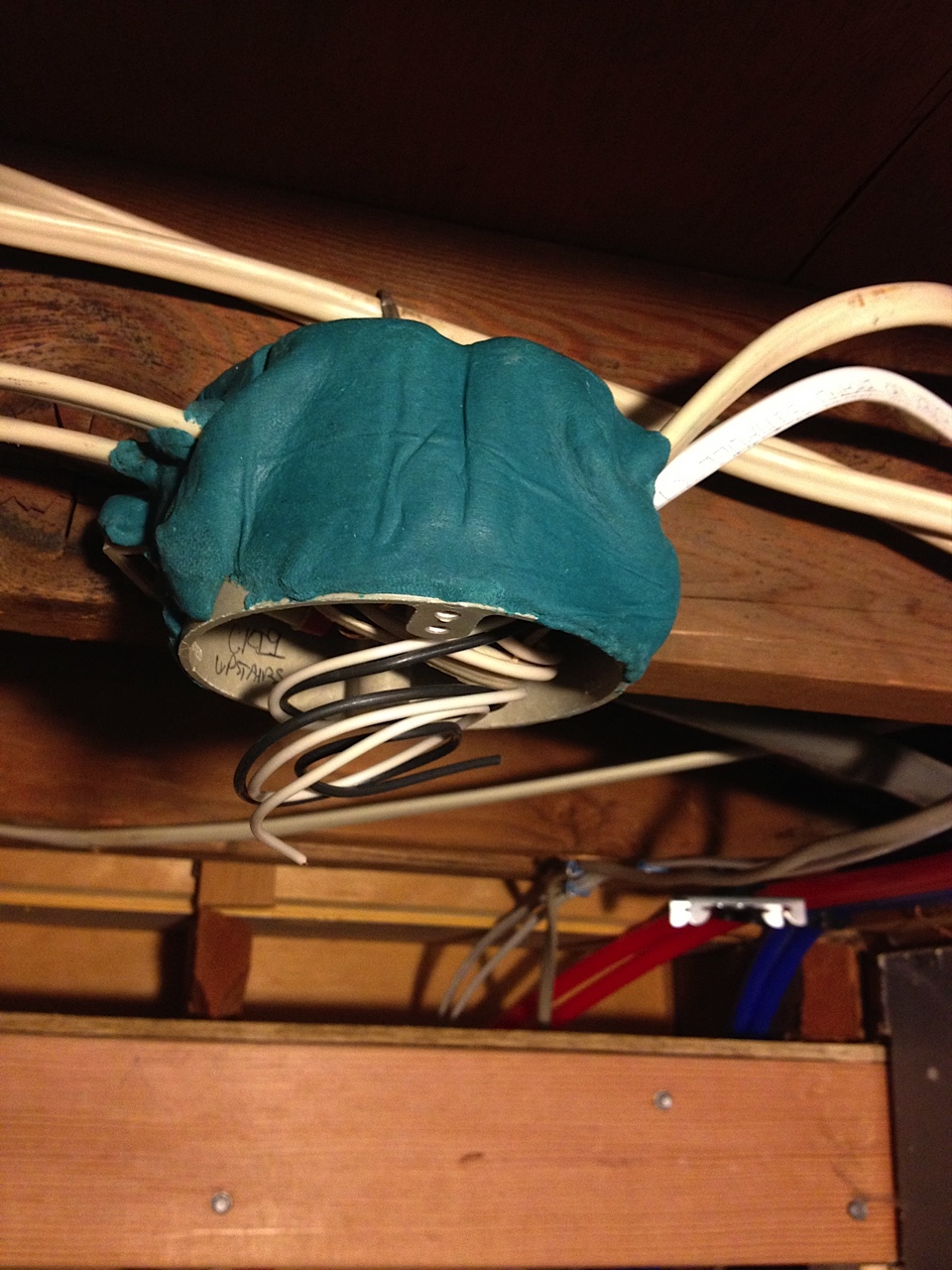
This thing that looks like a boring old light is actually going to become a smoke and CO2 detector…
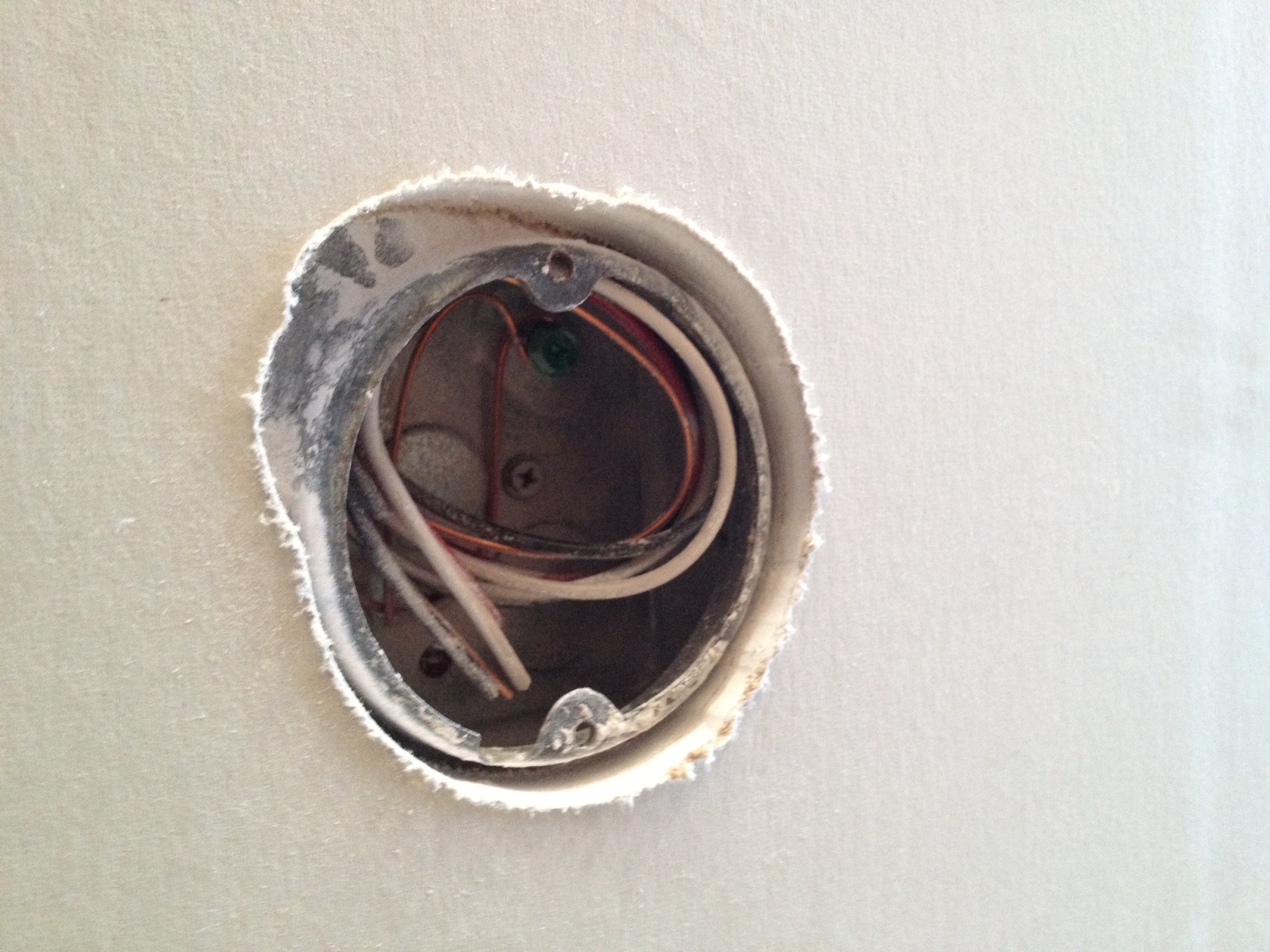
To complete the soundproofing, the gap between the detector’s electrical box and ceiling gyp board will be filled with non-hardening acoustical caulk. The box itself will be wired to another one by the upstairs bedrooms and to a heat sensor in the garage. If one unit is triggered all three will sound the alarm, giving us the best chance to get out and get the fire department here.
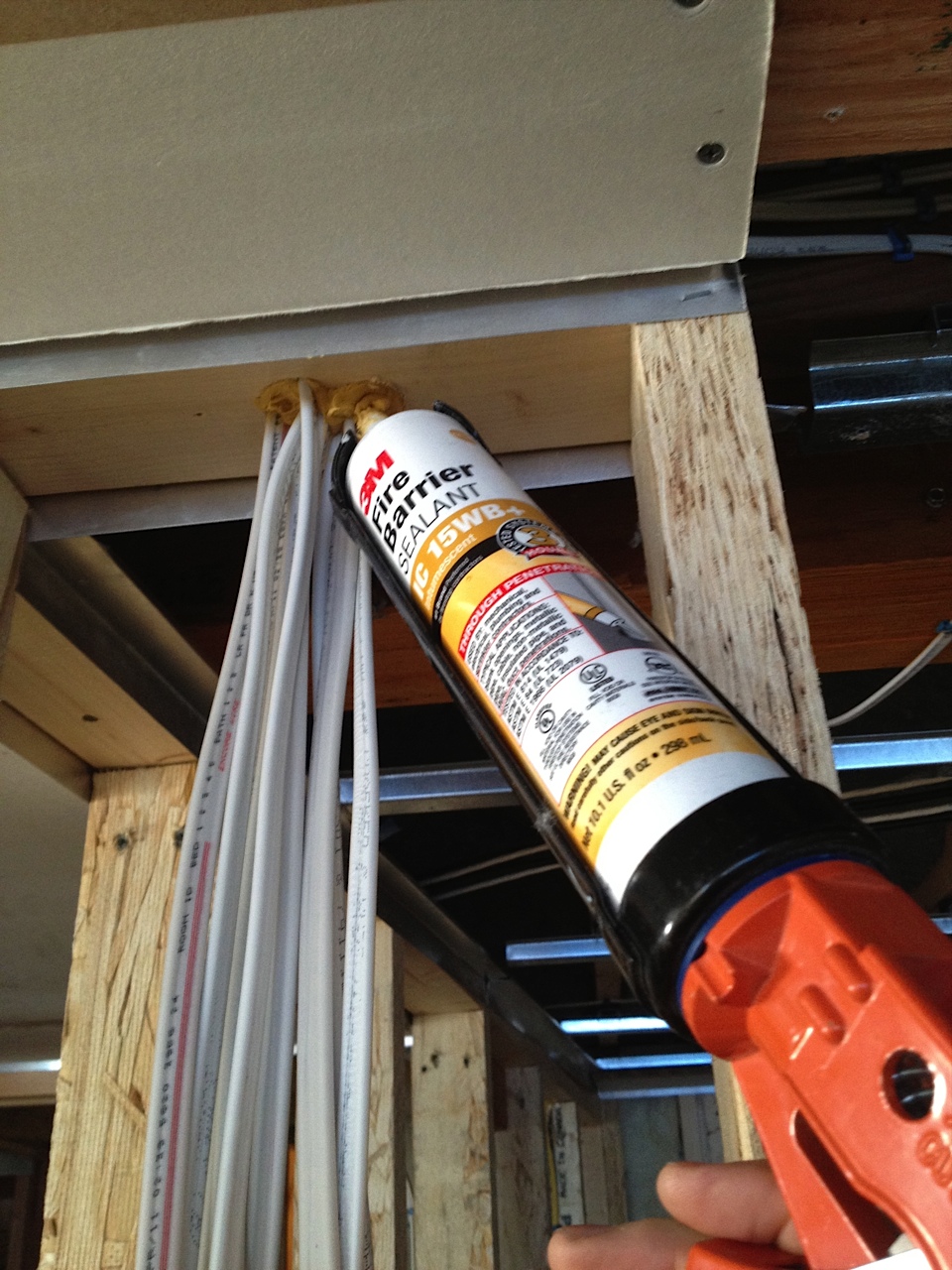
All pipe and wire penetrations are getting sealed against air and noise passage as well as against fire. Special fire-rated caulk first, then expanding foam where appropriate…
Last minute additions to the A/V network: more smurf tube. One run from the desk area to the stereo cabinet to get digital music from the computer to the DAC, and a video cable to allow use of the TV as a monitor. Mmmmmm, 50” internets…
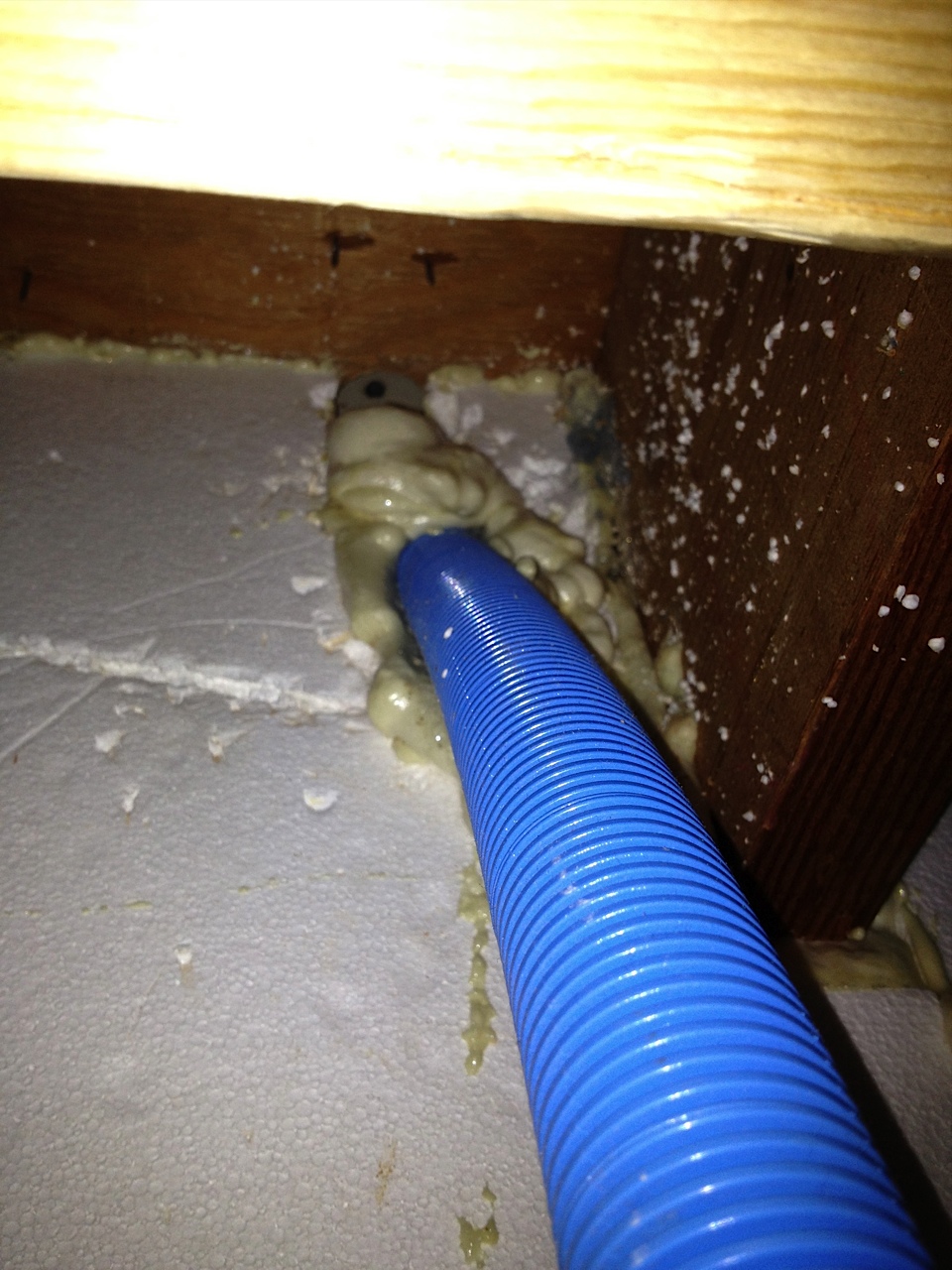
The other run goes from behind the TV to the future home of the upstairs stereo to allow for AM/FM and TV signal wires…
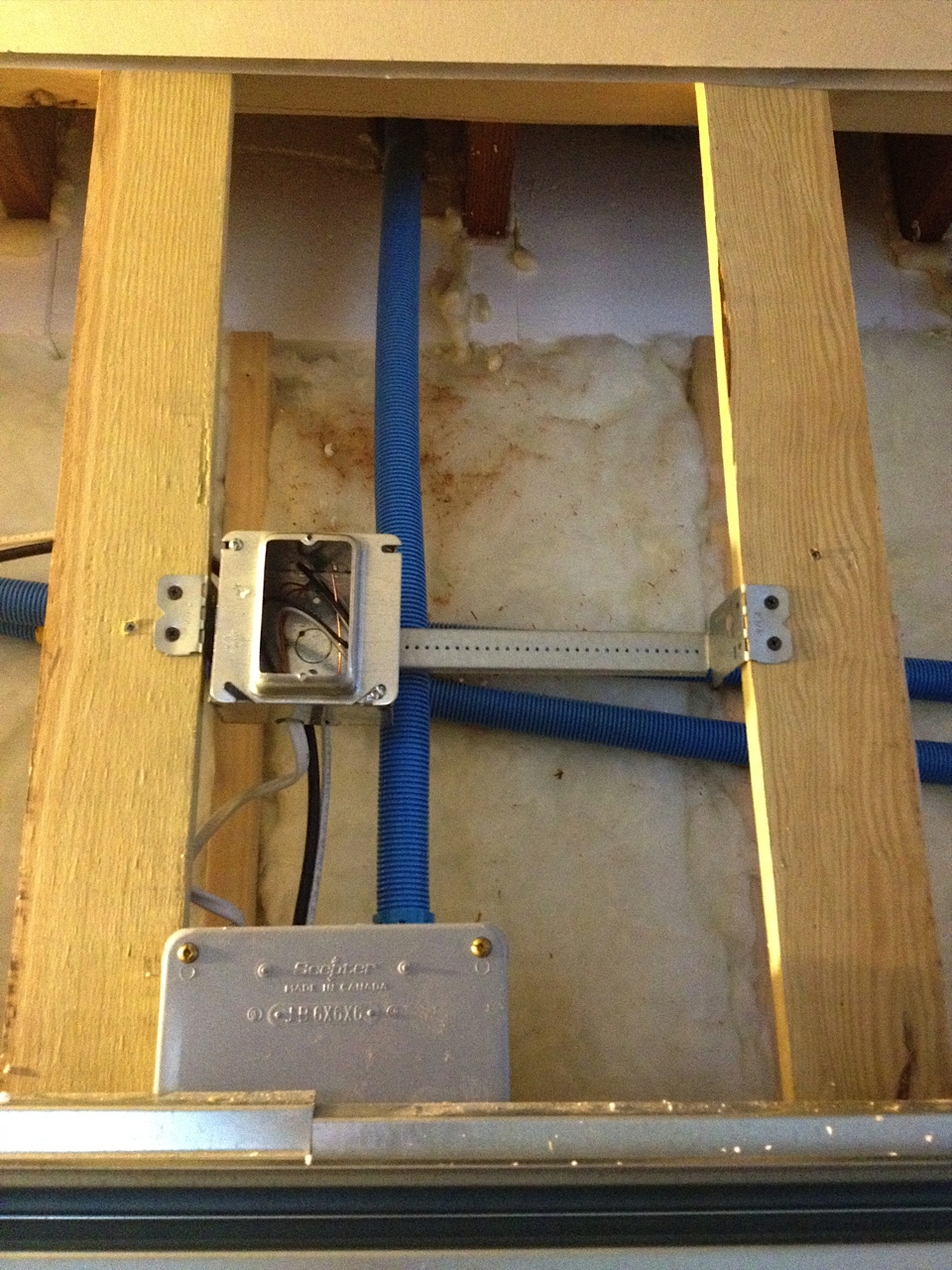
Someday soon we’re going to put antennas on the roof. That way we’ll be able to pull in distant radio stations and if the cable ever goes out we’ll still be able to get local TV channels.
More than once, we’ve discussed flooring for our entryway. That’s this area here with the lovely particle board floor…
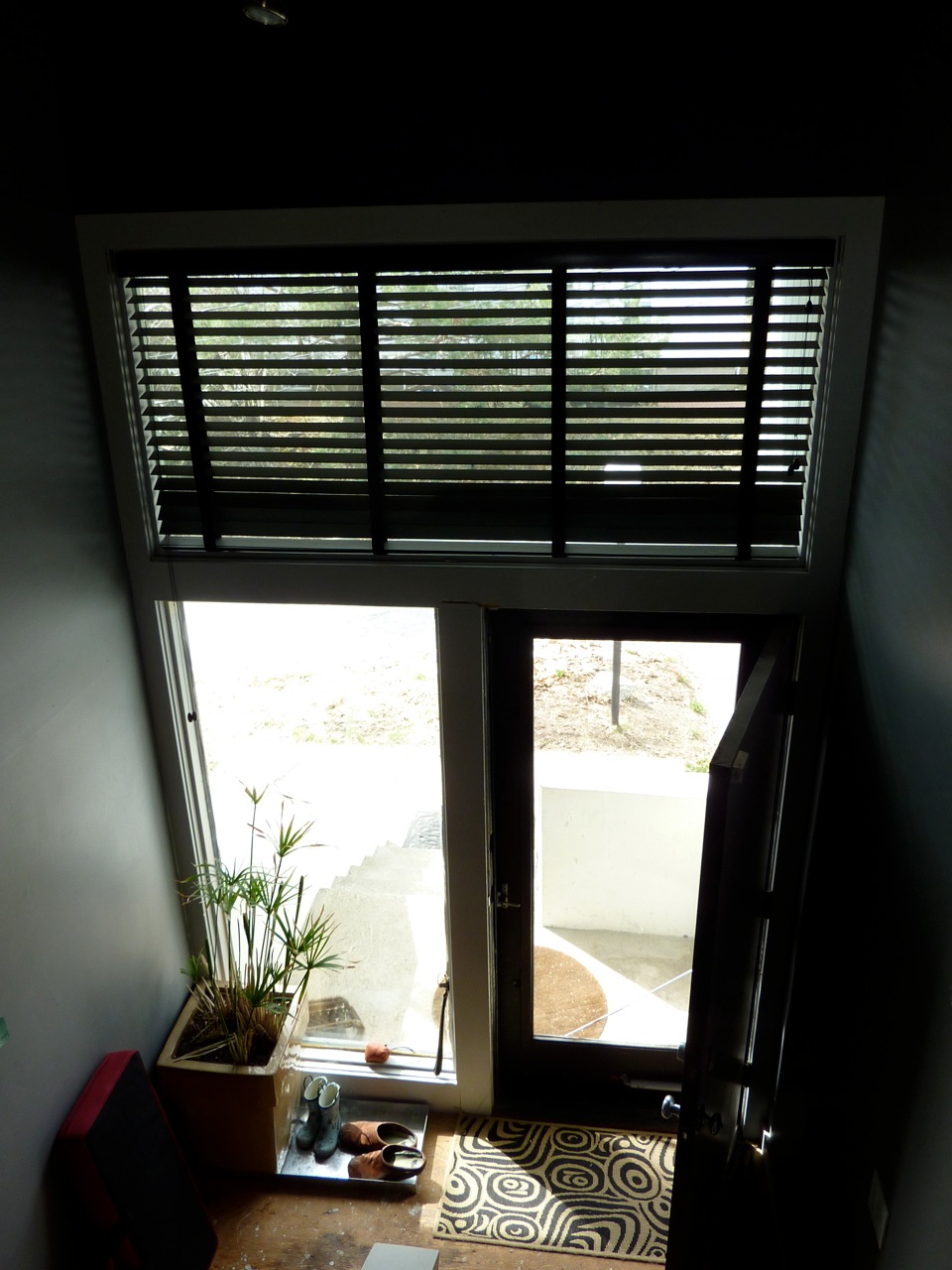
We’ve been round and round possibilities to go with the cork we’re using as our primary flooring. We’ve looked at terrazzo tile. We’ve looked at concrete tile. I thought we’d settled on this, but now David and I are revisiting the subject.
This is why we’re noncommittal: Initially we hoped the cork would work everywhere, including the entryway. It’s durable. It doesn’t mind when water’s tracked in. But when it comes to stairs…
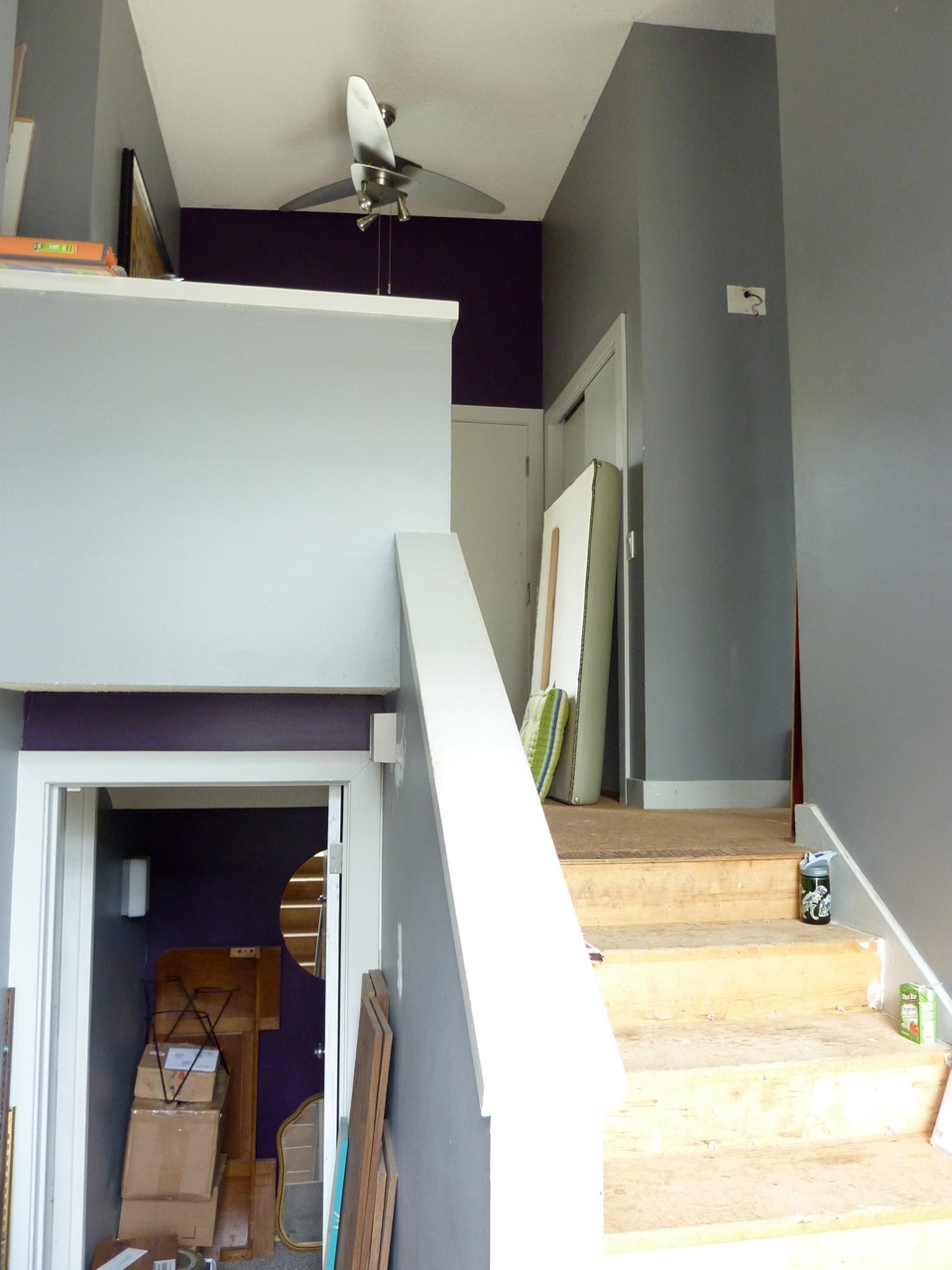
… the nosing on the risers would have to be wood or metal. Not the worst thing, I suppose, but that’s when we decided to consider tile. A tile riser with a tile nose is a more cohesive look. Of course, it would be noisier than cork. And colder. Which is why now we’re also considering this: rubber cork.
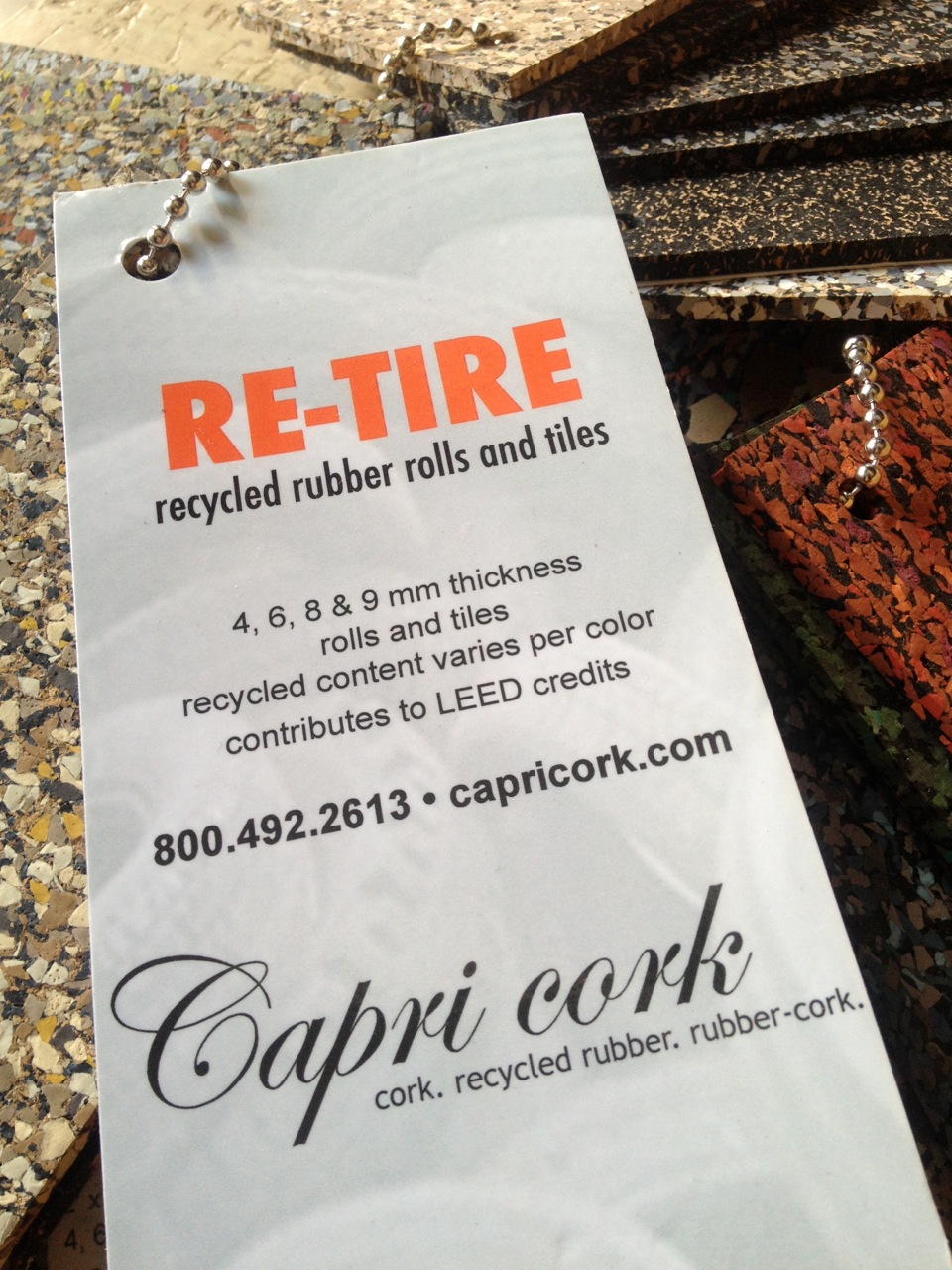
After much web surfing and multiple calls to flooring dealers, a Capri Rubber Cork rep called and pointed me toward Rustigian Rugs in Providence. David and I dropped in to see samples.
We like that Capri’s Re-Tire Medley collection combines recycled tire waste, post-industrial rubber waste, virgin rubber and post-industrial cork waste. Slip-resistant, sound absorbing and it contributes to LEED points. Nice!
The Peppercorn sample plays well with our cork sample…
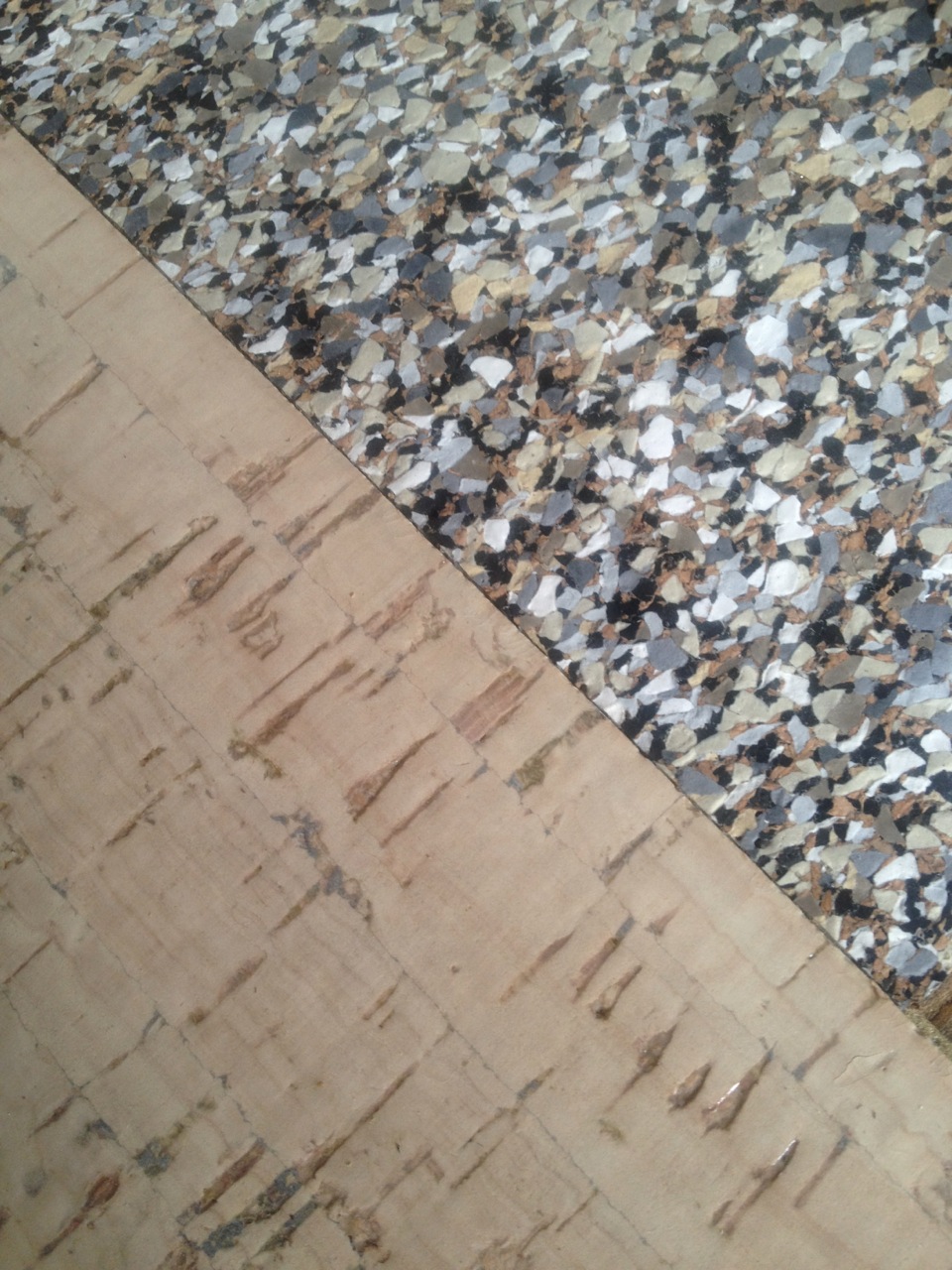
Kinda looks like terrazzo, doesn’t it?
Still undecided. Like cork, rubber requires separate nosing — although steel or aluminum would look pretty sweet with the steel cable railing we’re planning. It runs about $11 a sq ft and a minimum order is 200 sq ft. (Or we could just use the cork everywhere after all?)
It also requires an acrylic or urethane finish coat available from Capri. I optimistically assume the sealer would encase that heady scent of eau du tire factory. One can only hope.
David will now pick up where I left off last week.
—————————————————————————————-
So Joe and I got a bunch of gyp board (aka sheetrock or drywall) hung on the downstairs ceiling. As Brook pointed out, it’s a ⅝”-thick product called QuietRock. I chose it specifically for its soundproofing, noise-reducing qualities as the downstairs will eventually be our entertainment area. We don’t want to hear action movie blasts and techno beats through the floor upstairs.
Quietrock is made up of (from front to back): paper, ⅜” gypsum, a layer of a non-hardening viscoelastic glue, ¼” gypsum and paper. It’s still a Type-X fire-rated product but has much better sound dampening characteristics than standard ⅝” gyp board. It also differs from standard sheetrock in having a paper-wrapped long edge which is not removed upon installation….
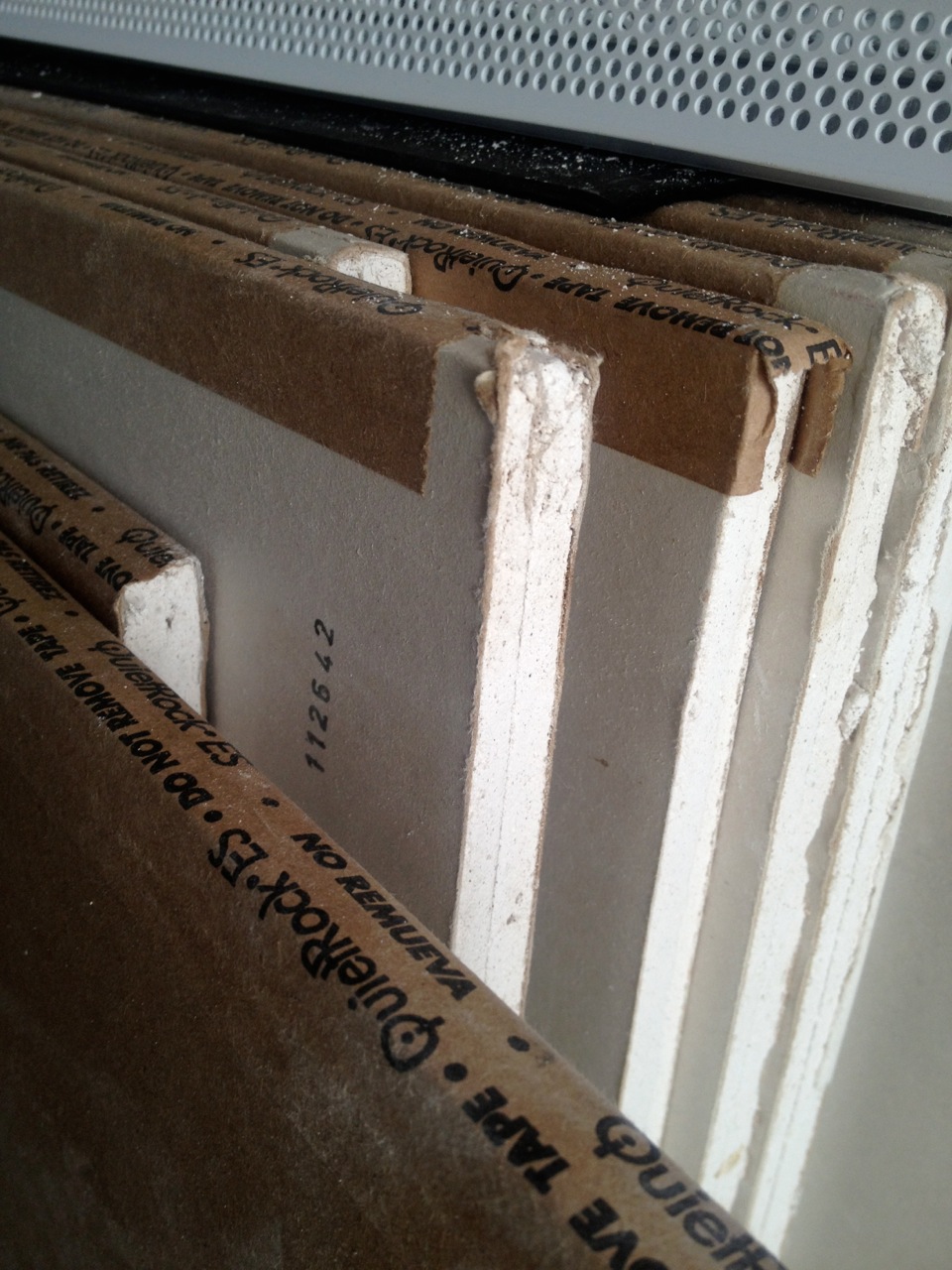
No matter what kind of gyp board you use, there’s a trick to getting a really flat wall or ceiling with it. The long edges come from the factory with a taper that allows for the thickness of the joint compound and tape you’re going to add, so that the separate pieces of gyp board become one monolithic, smooth mass. But the short edges have no taper and if left to their own device will make a visible hump when taped. You see this all the time. Here’s a typical wall in our house…
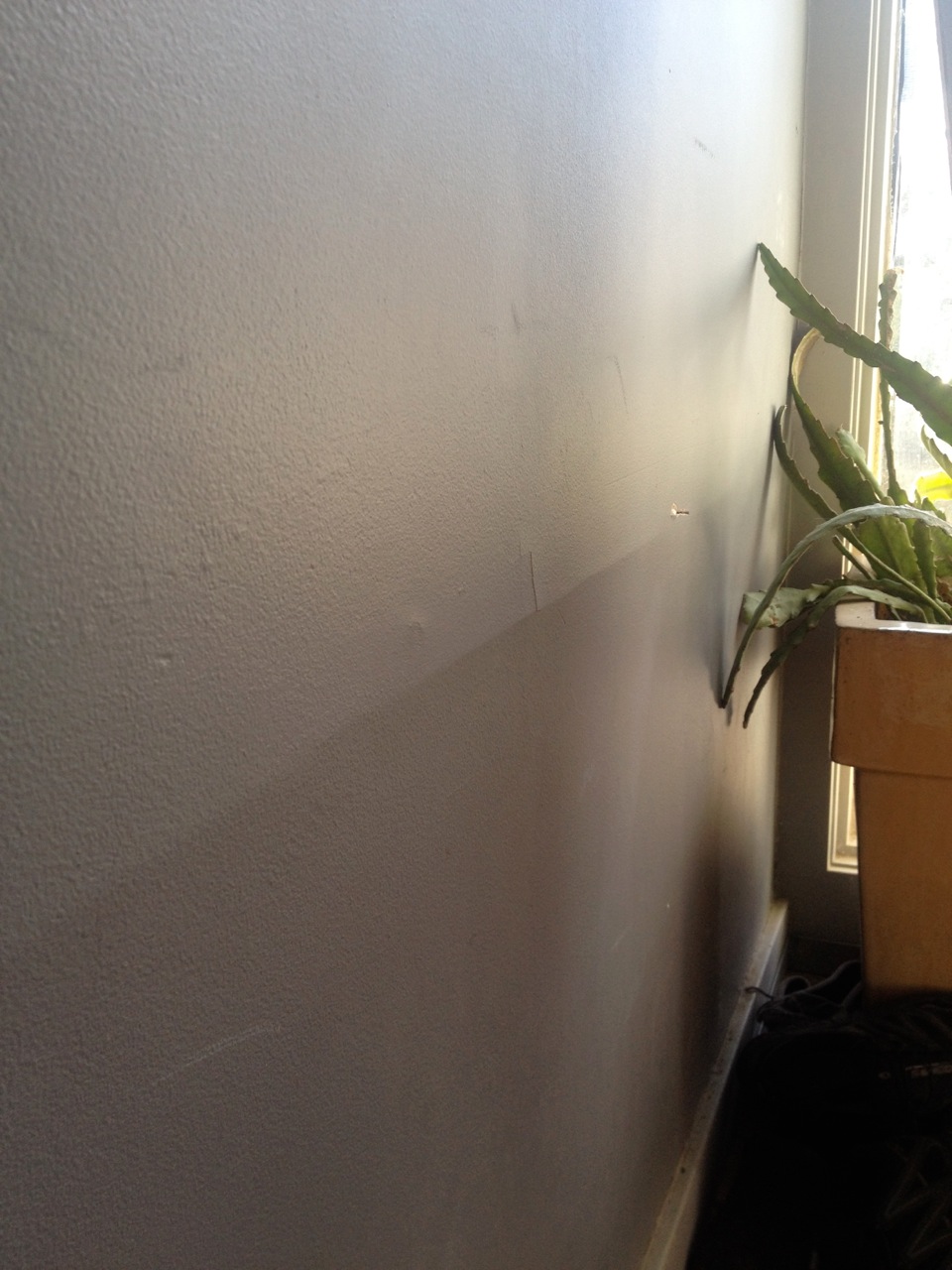
The solution, if you plan ahead, is to buy one of several products that screw to the back of the adjoining pieces to pull their edges into a taper. Failing that foresight (ahem, I did it again), you can make your own butt splice — that’s what Joe and I did. Butt splice: splice the gyp boards together with another board behind the gap where they butt up against each other.
To make the butt splice, first I picked up 1/16″ mat board at my local art shop. Then I cut it into 1″ strips and stapled it to plywood planks (same thickness as the drywall, sized 9-1/4″ wide x an inch shorter than the length of the joint) along both long edges…
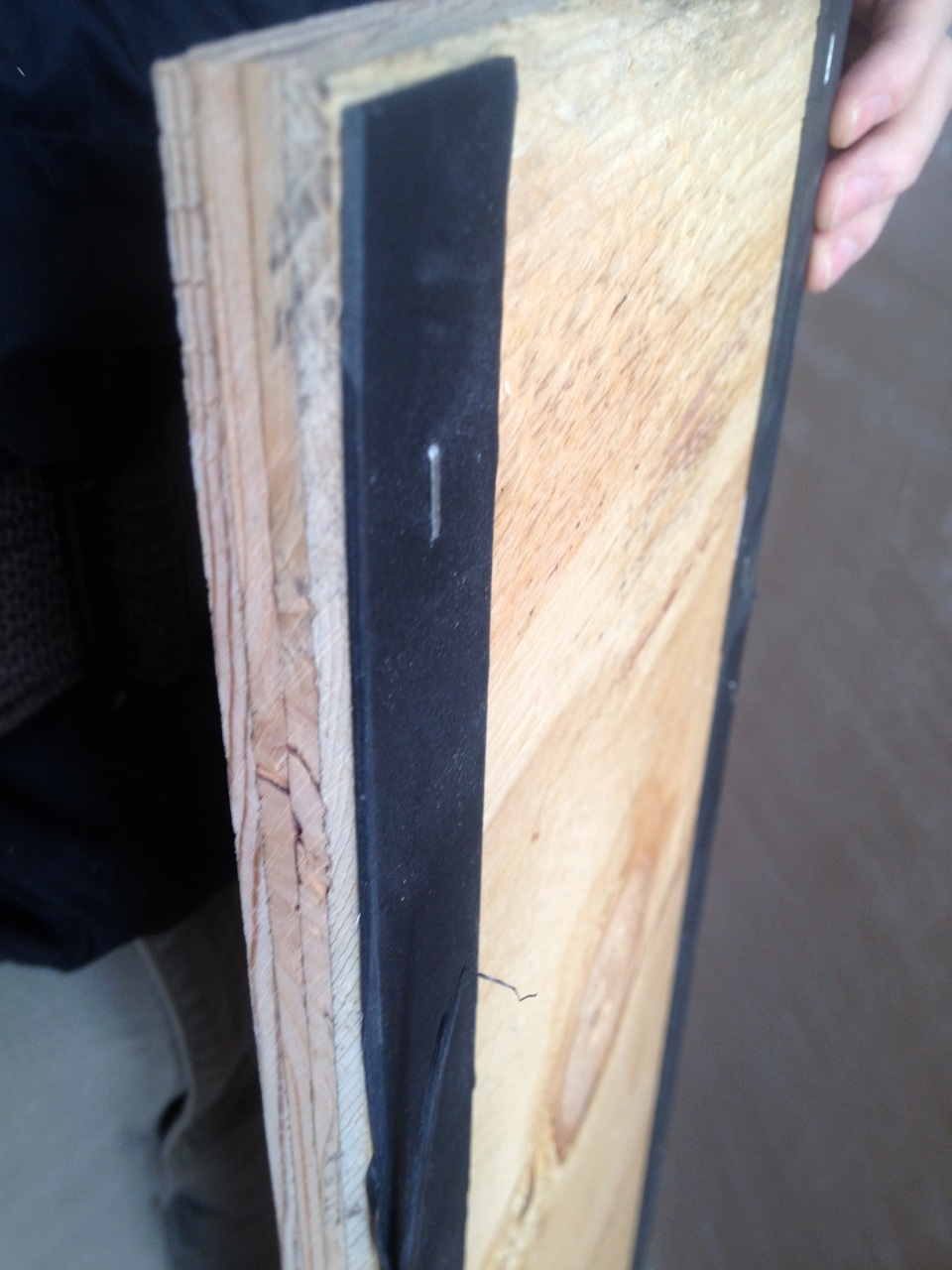
As each sheet of QuietRock went up, we screwed the finished splices to the backside like so…
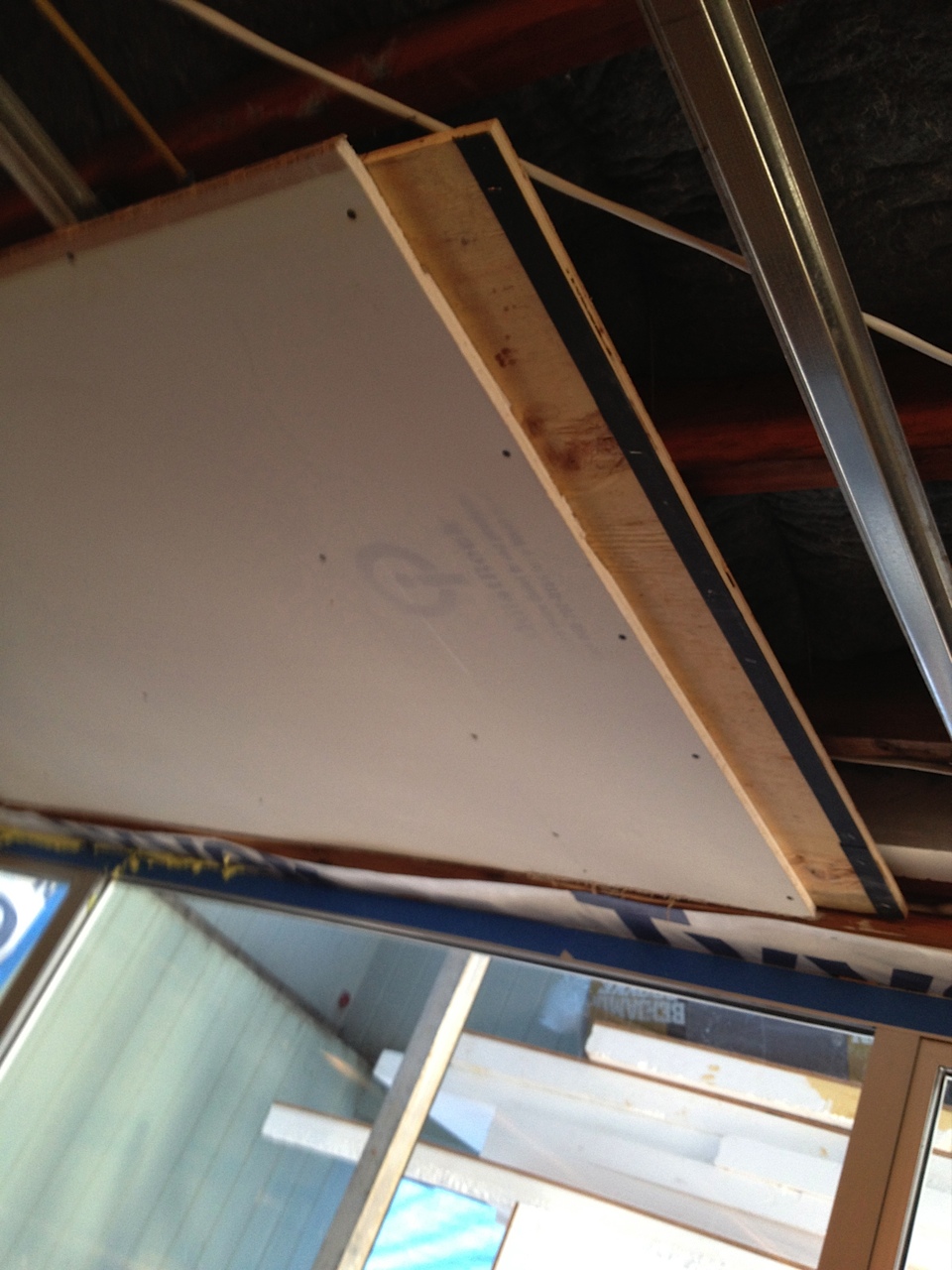
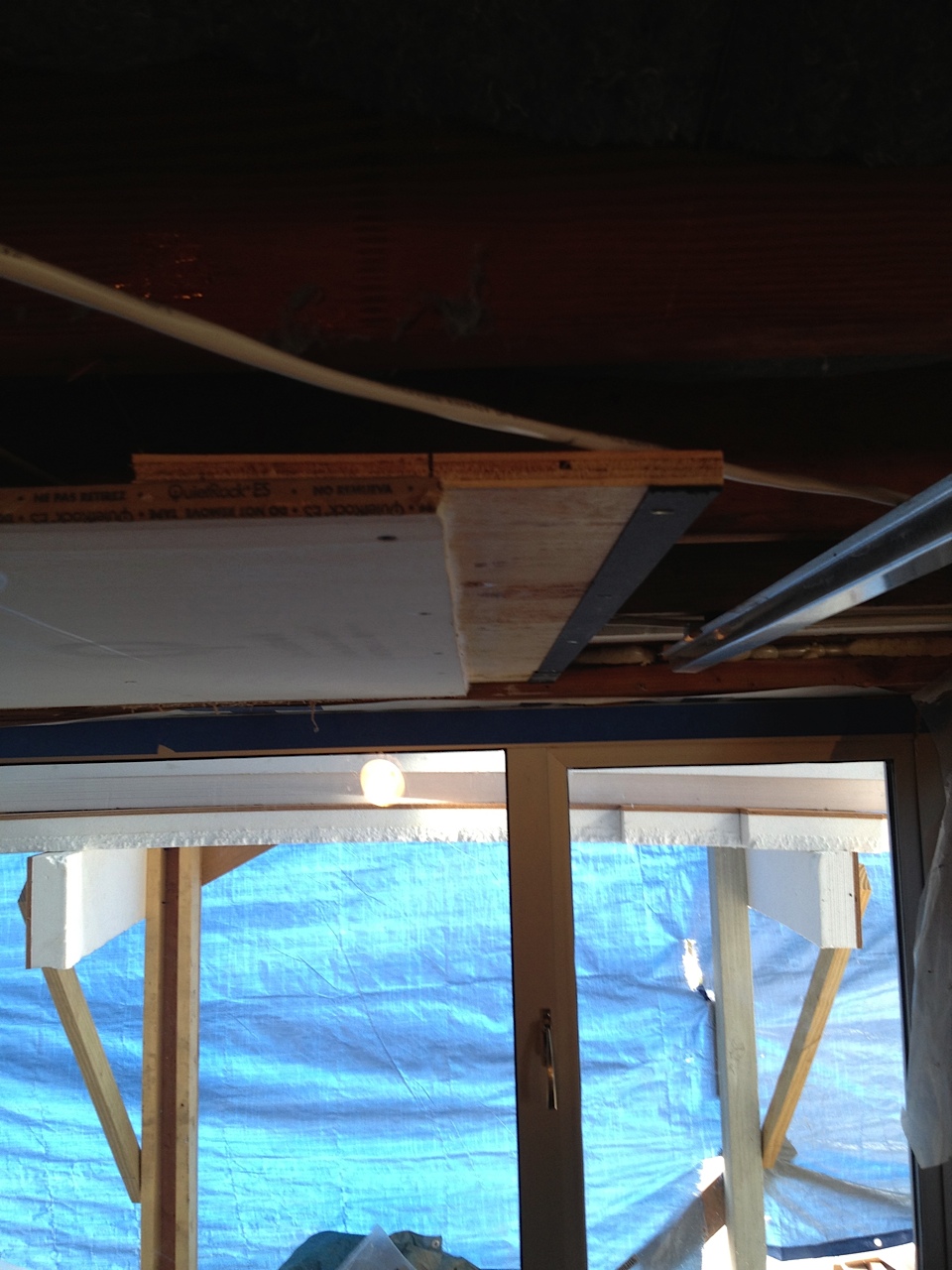
As the two pieces of gyp board are screwed to the plywood along their edges, they flex upwards slightly along the screw line…
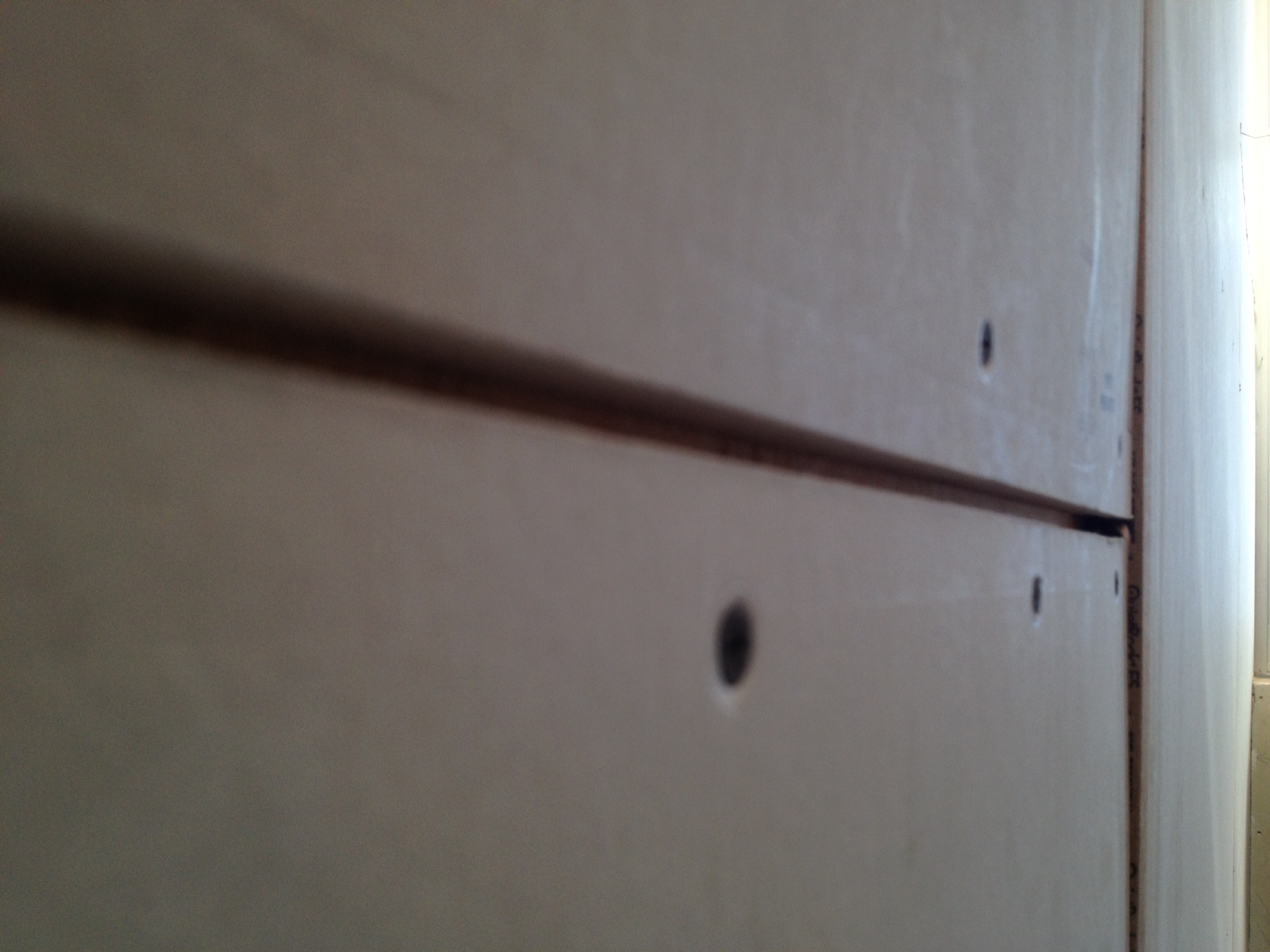
That creates a tapered edge which will take tape and compound just like a factory taper. Voila! Super smooth ceiling or wall! Tape and compound still to come…
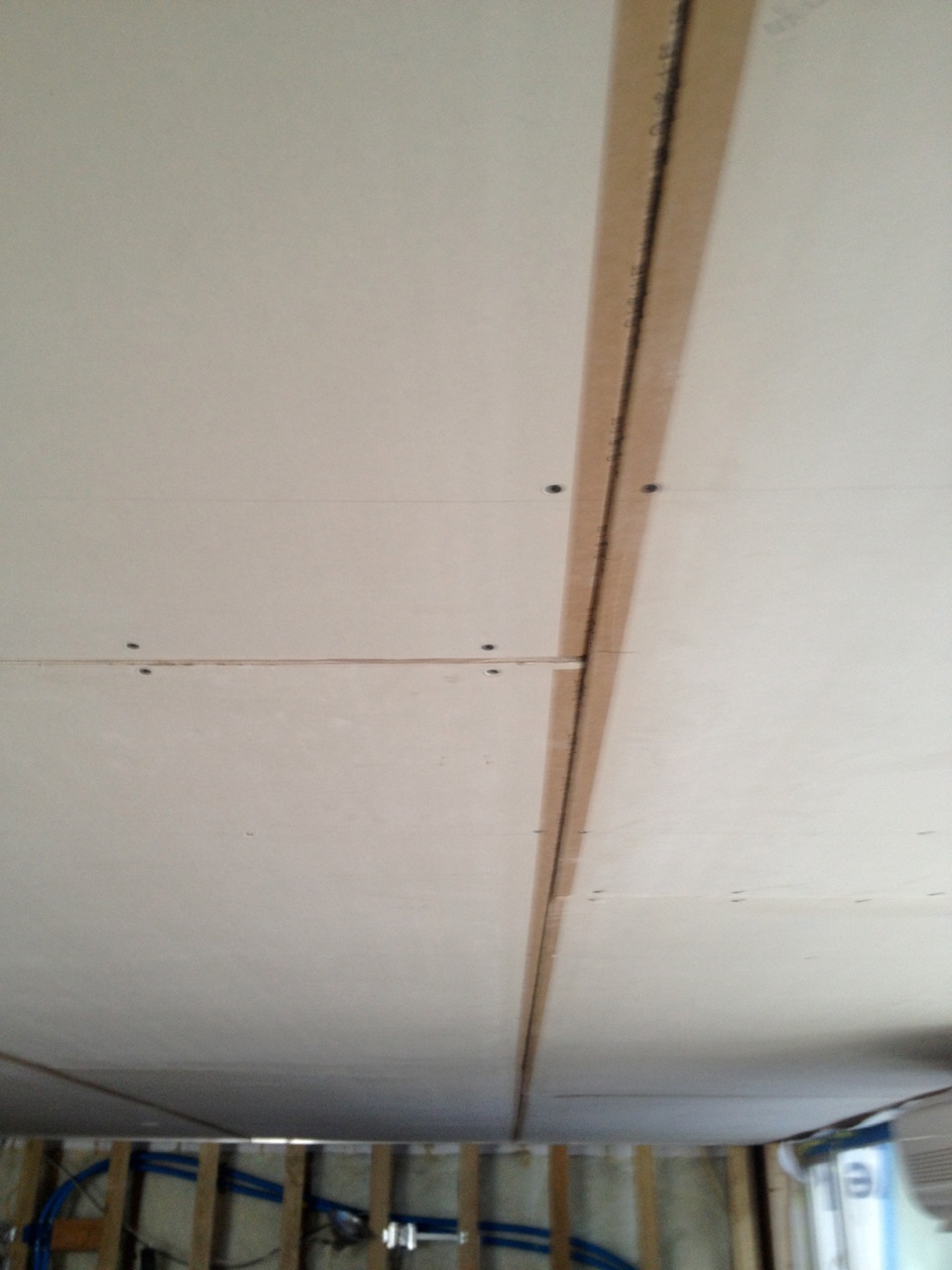
But first, we have to finish the rest of the ceiling and walls.
[FYI, the process we used above is Fine Homebuilding’s butt splice tip in action. Thanks, FH!]
So how’s it going with the sheetrock installation today? David can give you the pro’s point of view in another post. I just want to show you how quickly the construction zone is starting to look pulled together.
This was the scene this morning…
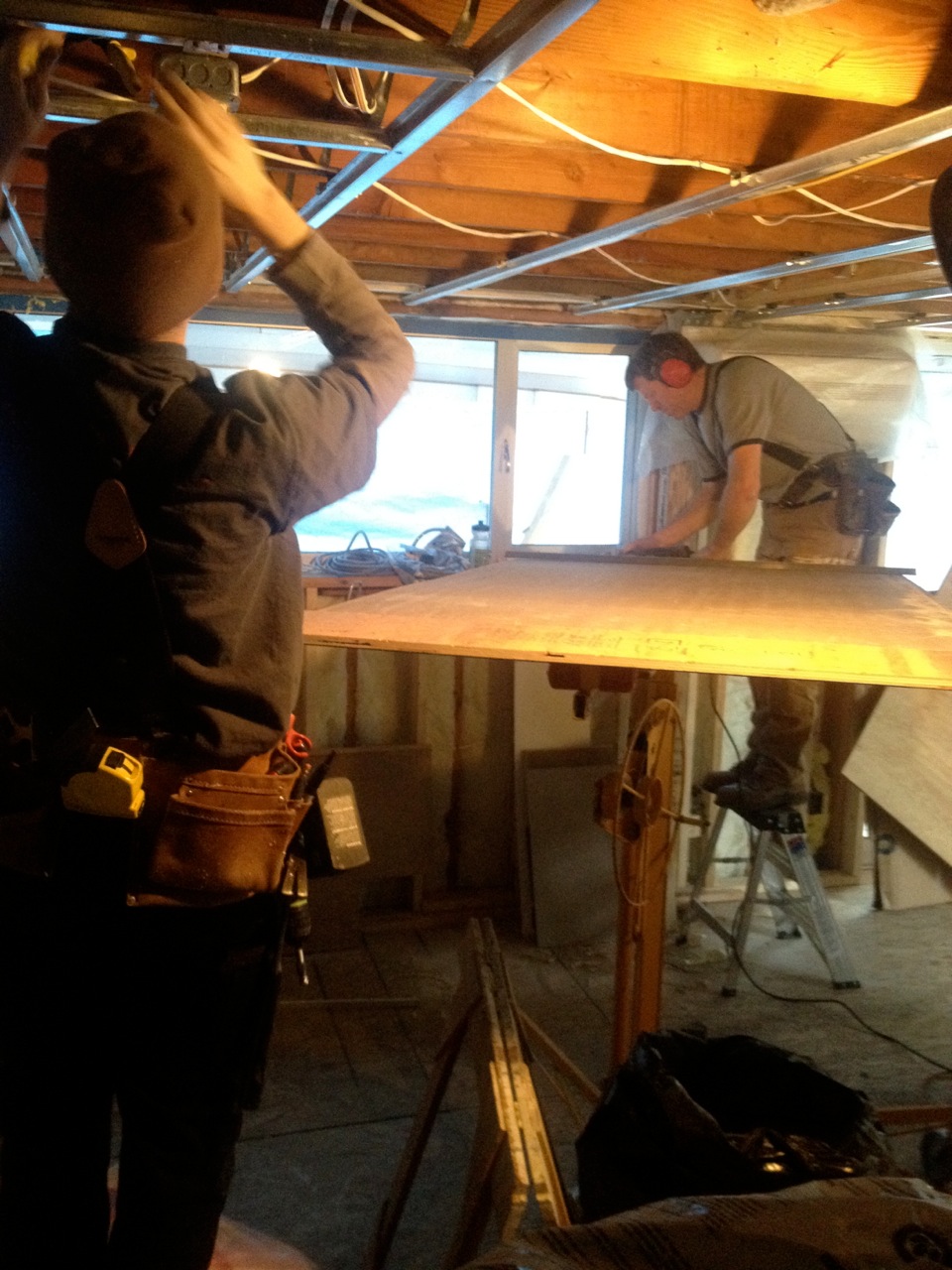
Then the first sheet of Quietrock went up…
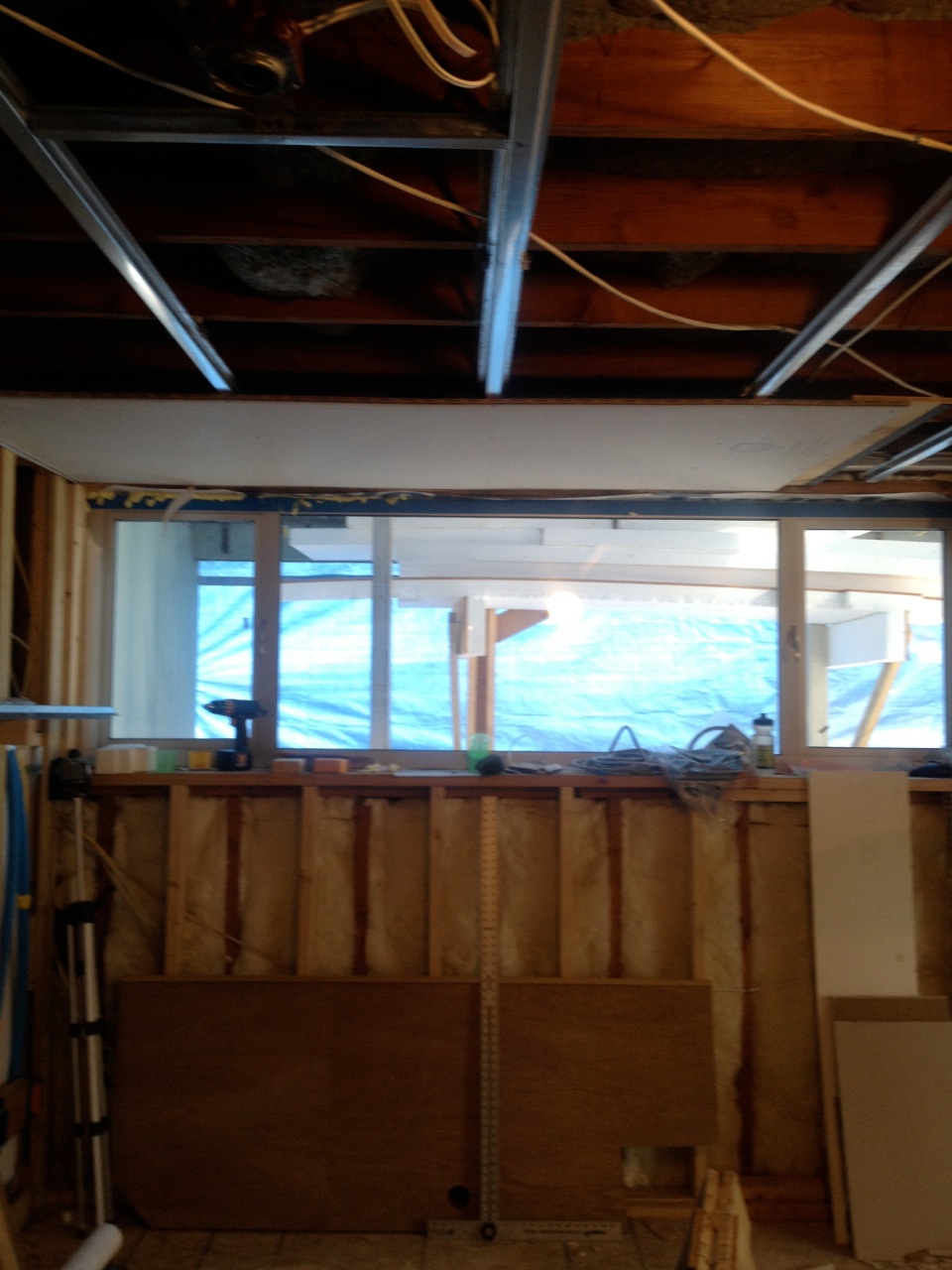
Followed by sharp objects cutting into sheet goods…
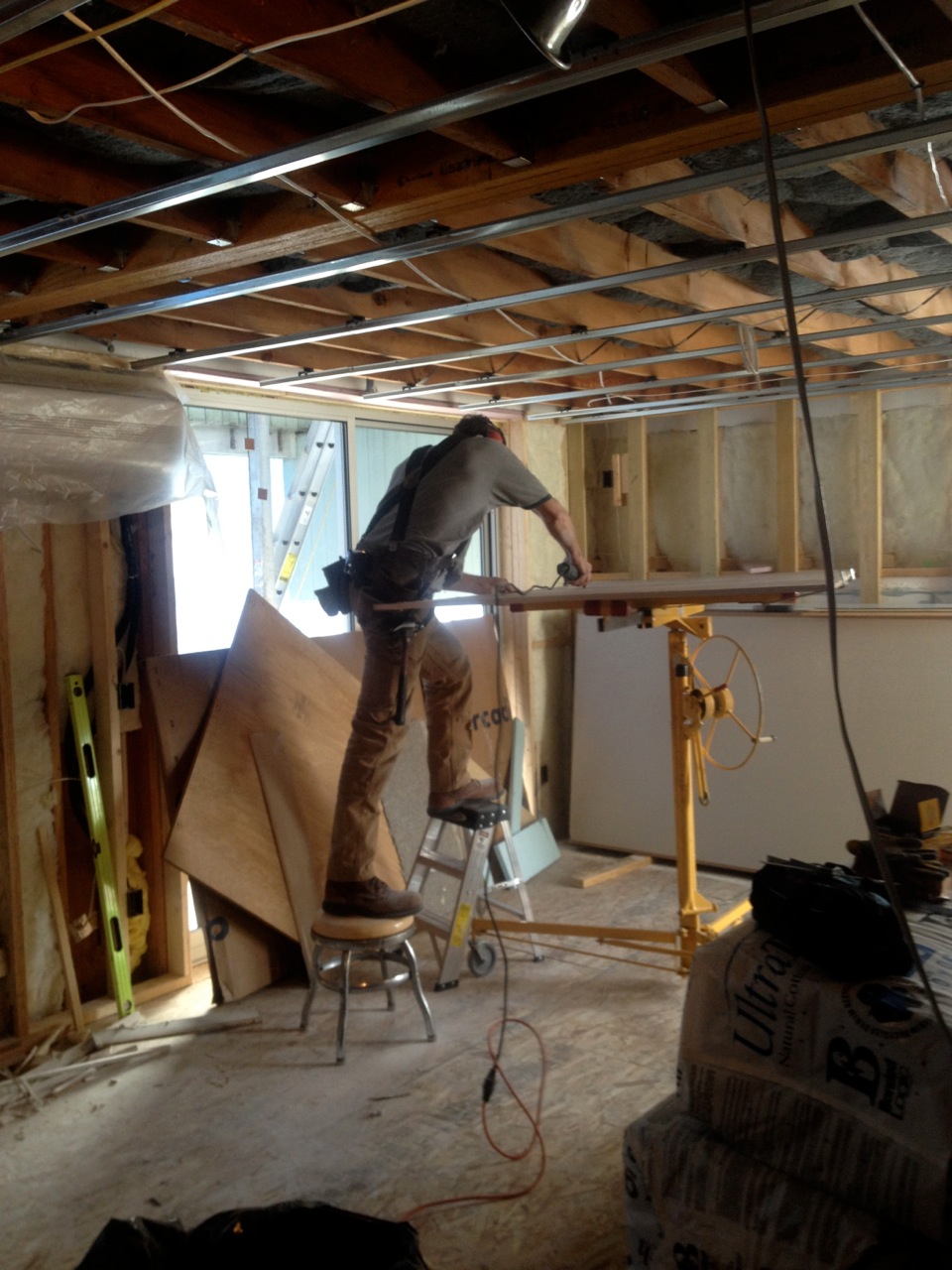
And another sheet went up…
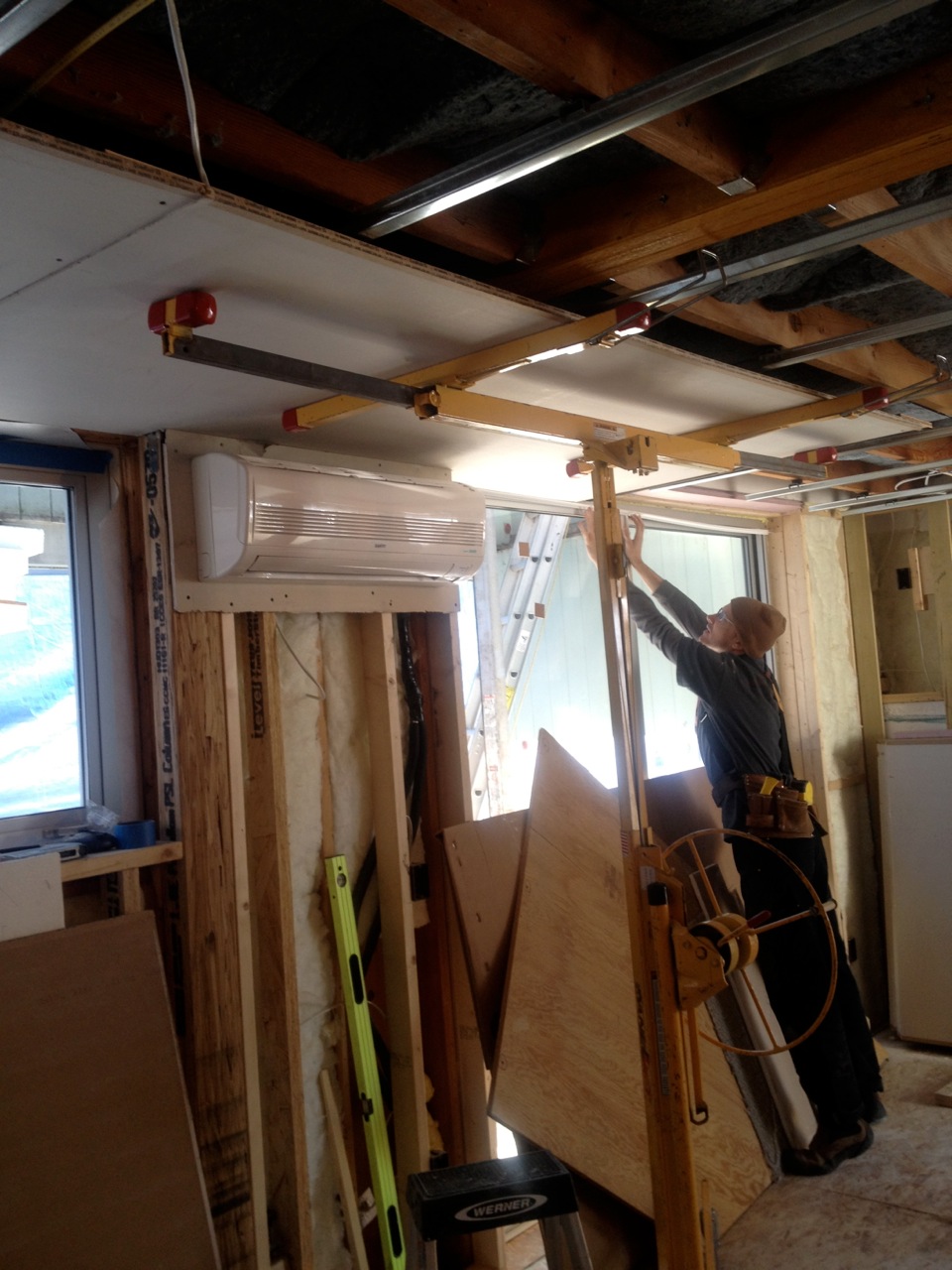
And then another…
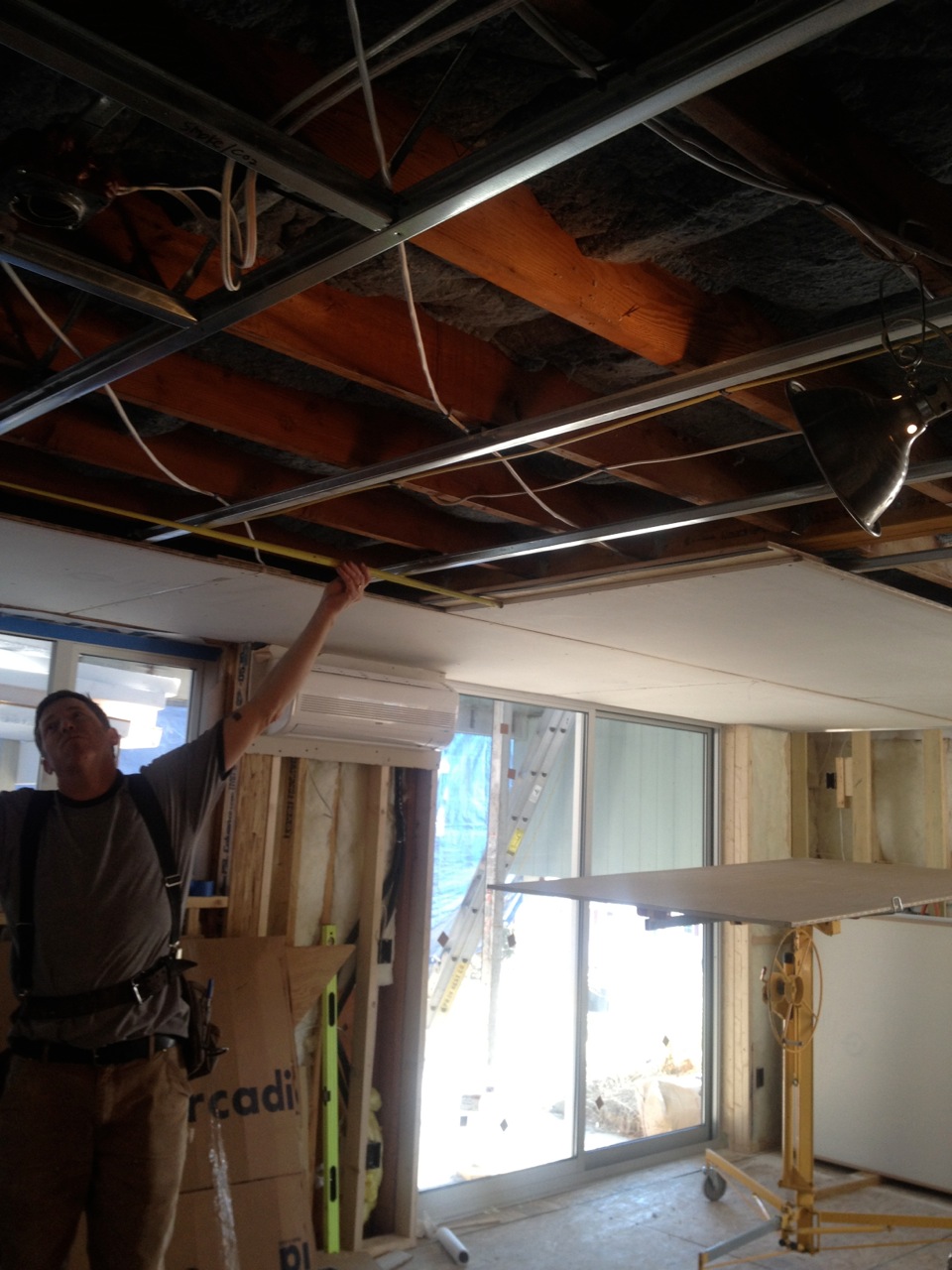
And so on, with tools and such…
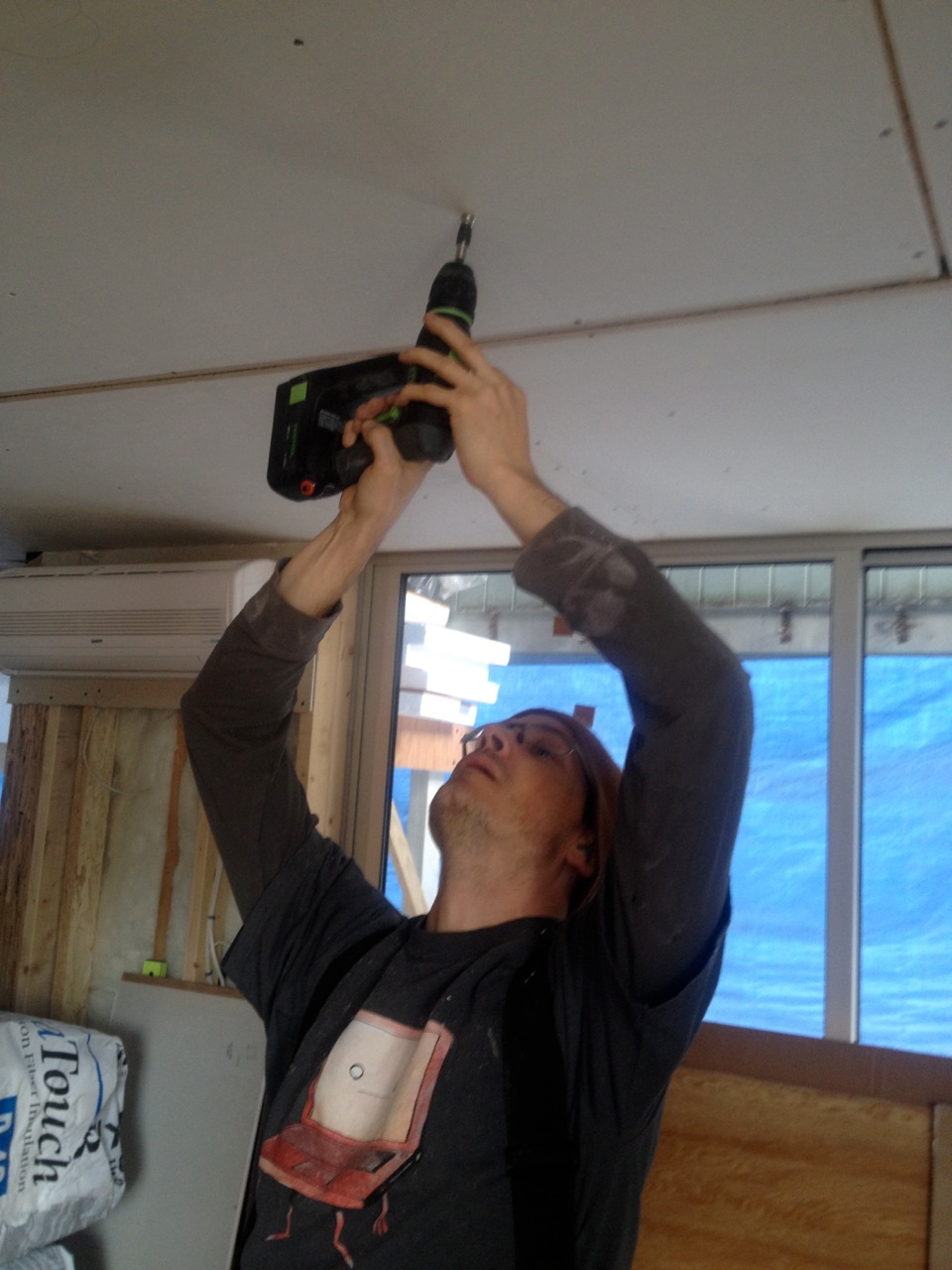
And then lo and behold, it suddenly looks like a ceiling!
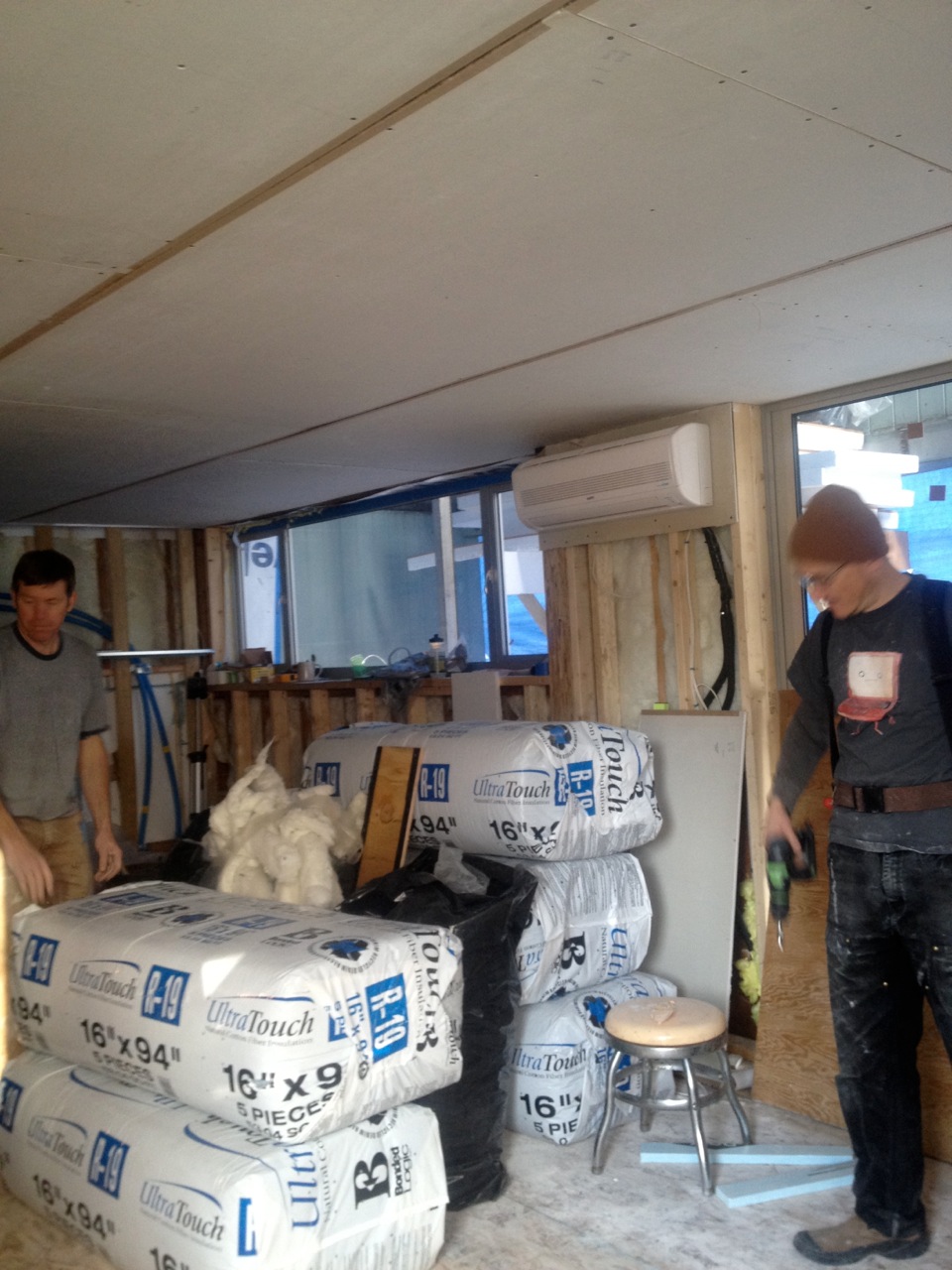
There was more to it than that, of course. The Magic Man can fill you in on the construction details. The Layman-type Girl (that’s me), is pleased. Thanks, Joe and David!
The QuietRock drywall from Acoustical Supplies, she has arrived…
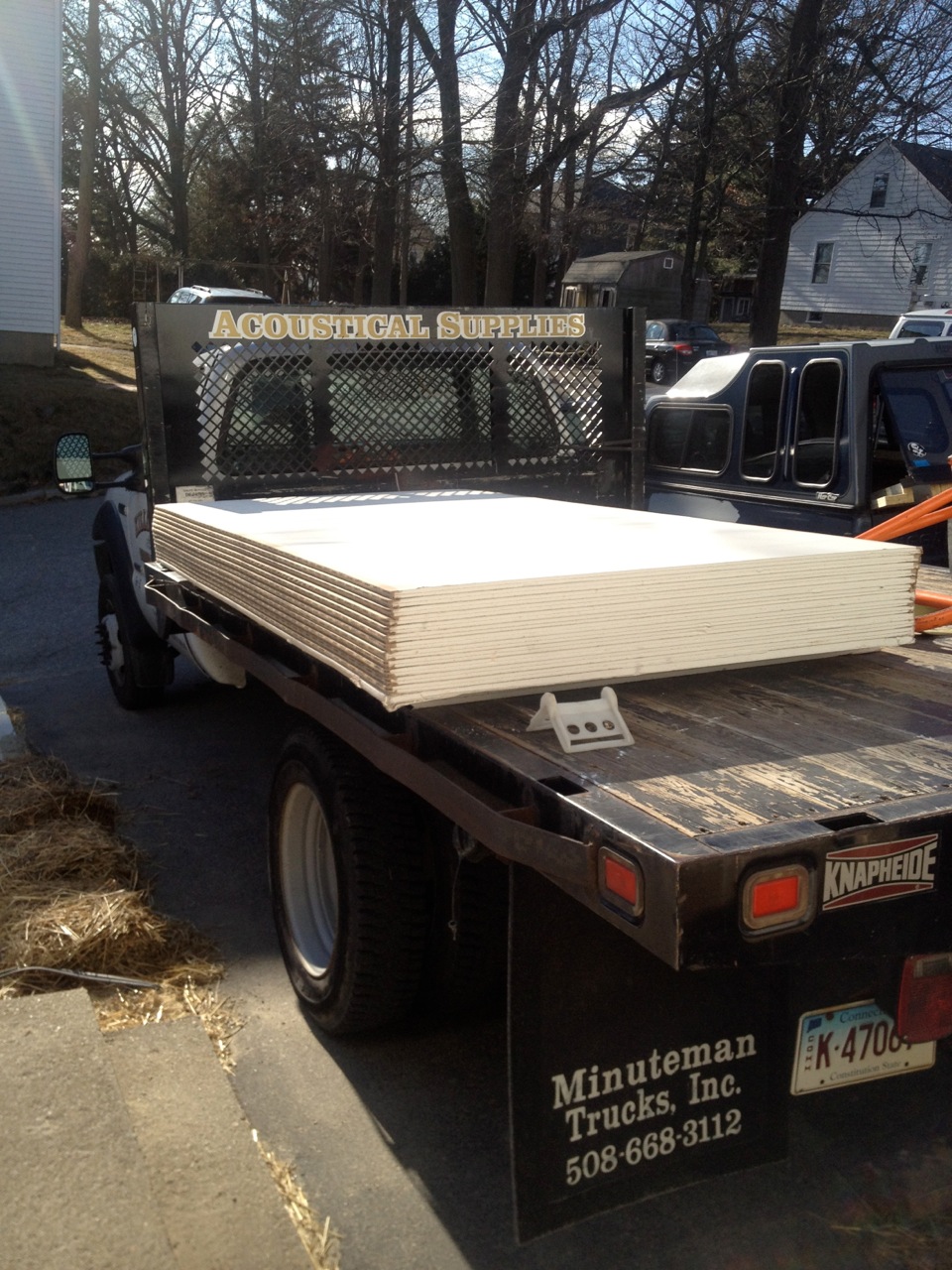
The boys were halfway through unloading when I shot that. Goes up tomorrow. I have it from credible sources that today was all about prep.
Just kidding. Hey, we passed our electrical inspection. YAY! Also passed our plumbing inspection and building inspection. Now that the powers that be have given their official nods of approval, the walls can finally get closed up. Sheetrock arrives tomorrow morning. Onward…